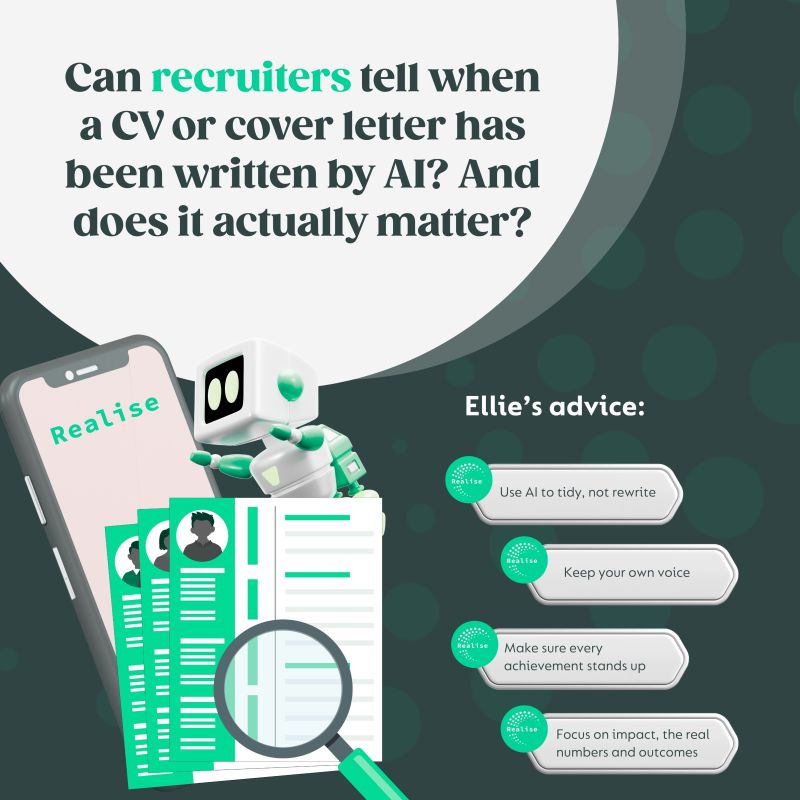
Article
Read the full piece
Will AI Replace Recruiters? What It Means for Your CV
Artificial Intelligence is changing recruitment.
AI can analyze information, search databases, identify patterns, automate repetitive tasks, and support recruiters in handling large numbers of applications.
This has created a major question among job seekers:
“Will AI eventually replace recruiters?”
The short answer is: AI may change the recruiter’s job significantly, but recruitment is unlikely to become purely machine-driven.
Hiring people involves more than matching keywords.
Recruiters and hiring managers must understand context, assess communication, evaluate potential, consider organizational needs, conduct interviews, and make human judgments.
But there is another question that matters even more for job seekers:
If AI changes how recruiters work, how should you change your CV?
1. Recruitment Is Becoming More Technology-Driven
Recruiters today may have access to tools that help them:
Organize applications
Search candidate databases
Identify relevant skills
Compare candidate information with job requirements
Automate repetitive administrative tasks
Schedule interviews
Communicate with applicants
Support screening and decision-making
This means recruiters can potentially handle more information in less time.
For candidates, that creates both an opportunity and a challenge.
Your CV needs to communicate your value clearly enough to be discovered in a digital recruitment environment.
2. AI Is More Likely to Change Recruiters Than Simply Replace Them
Recruitment contains many repetitive tasks that technology can support.
For example, a recruiter may spend significant time reviewing applications, organizing candidate information, scheduling interviews, and searching for particular skills.
AI and recruitment software can assist with some of these activities.
But hiring decisions often require human judgment.
A recruiter may need to ask:
Does this candidate actually understand the role?
Does their experience make sense in context?
Can they communicate effectively?
Can they demonstrate the required competencies?
Will they work effectively with others?
What evidence supports their claims?
Is their experience relevant to our specific environment?
These questions cannot always be answered by keywords alone.
“AI can identify information. Humans still need to understand its meaning.”
3. Your CV Must Become Easier to Understand
If recruiters have technology helping them process large numbers of applications, clarity becomes even more important.
Your CV should make it easy to identify:
Who you are.
What you do.
What you have achieved.
What skills you bring.
Why you are relevant to the position.
Avoid making recruiters search through paragraphs to discover your most important qualifications.
Put relevant information where it can be easily found.
4. Your Professional Identity Matters More Than Ever
Imagine a recruiter searches for candidates with experience in:
Monitoring & Evaluation + Data Analysis + Reporting
If your CV contains these capabilities but presents them vaguely, you may not communicate your relevance effectively.
Your professional headline and summary should clearly position you.
For example:
Monitoring & Evaluation Professional | Data Analysis | Programme Reporting | Results-Based Management
This is much more informative than:
“Hardworking Professional Seeking New Opportunities.”
Your CV should answer the recruiter's first question quickly:
“What kind of professional is this?”
5. AI Makes Generic CVs More Dangerous
As more candidates use AI to create CVs, generic language may become increasingly common.
You may see phrases such as:
Results-driven professional
Strategic thinker
Highly motivated
Excellent communicator
Dynamic team player
Passionate professional
There is nothing inherently wrong with these descriptions.
The problem is when they appear without evidence.
Instead of saying:
“Strong leadership skills.”
Show leadership through your experience.
For example:
“Led a cross-functional team to coordinate project activities and deliver agreed outputs within established timelines.”
The second statement provides something the recruiter can evaluate.
6. Evidence Will Beat Empty Claims
AI can make almost any CV sound professional.
That means professional language alone may not differentiate you.
Evidence will.
Whenever possible, demonstrate:
Scale
Results
Responsibilities
Improvements
Numbers
Projects
People supported
Revenue influenced
Costs reduced
Time saved
Processes improved
For example:
Before:
“Responsible for customer service.”
After:
“Handled customer inquiries, resolved service issues, and maintained accurate customer records to support efficient service delivery.”
The second version provides much more context.
7. Your CV Needs the Right Keywords—Naturally
Recruiters may use searches or filters to find candidates with particular skills.
That makes relevant terminology important.
If the vacancy asks for:
Budget Management, Financial Reporting, Tax Compliance, Audit Support
and you genuinely have those skills, make sure your CV communicates them clearly.
But do not copy every keyword into your CV.
Keyword stuffing is not a career strategy.
Use terminology where it accurately describes your qualifications and experience.
“Don't write for keywords alone. Write for relevance, evidence, and understanding.”
8. Don't Try to Trick AI
There will always be people searching for “ATS hacks” and ways to manipulate recruitment technology.
That is the wrong approach.
Do not:
Invent qualifications
Add fake experience
Change employment dates
Create fictional achievements
Misrepresent your job title
Add irrelevant keywords
Hide keywords in the document
Instead, make your genuine qualifications easier to identify.
Optimization should improve discoverability—not create deception.
9. Recruiters Will Still Need Context
Imagine two candidates have the same keyword:
Project Management
One simply lists it under a skills section.
The other demonstrates:
Projects coordinated
Teams supported
Stakeholders engaged
Reports prepared
Problems solved
Results achieved
The second candidate gives the recruiter context.
This is why your CV should connect skills to experience.
Don't just tell employers what you can do.
Show them where you have done it.
10. Your CV and Interview Must Tell the Same Story
AI may help identify candidates, but interviews remain an important part of many recruitment processes.
This creates another important rule:
Never create a CV that you cannot defend in an interview.
If your CV says you have advanced expertise in a particular area, be prepared to explain:
Where you gained the experience
What you actually did
What challenges you faced
What results you achieved
What you learned
Your CV should open the door.
Your knowledge and experience must help you walk through it.
11. Tailoring Will Become More Important
AI makes it easier for job seekers to analyze different vacancies.
Use that opportunity.
For every important application, identify:
The employer's priorities
What problems does the organization need this person to solve?
The key requirements
Which qualifications and skills are essential?
The language of the role
What terminology does the employer use?
Your strongest evidence
Which experiences demonstrate that you can perform the job?
Then tailor your CV accordingly.
You do not need to rewrite your entire career history.
You need to prioritize the most relevant evidence.
12. Don't Let AI Remove Your Personality
A CV should be professional.
But it should not sound like it was produced by a machine.
Your CV should reflect your actual professional journey.
Use AI to:
Improve clarity
Correct grammar
Identify gaps
Suggest stronger wording
Analyze job requirements
Improve structure
But review the final result yourself.
Ask:
“Does this actually sound like me?”
If the answer is no, edit it.
13. The Recruiter of the Future May Be More Strategic
As technology handles more repetitive recruitment tasks, recruiters may have more time to focus on higher-value activities such as:
Candidate engagement
Employer branding
Interviews
Relationship building
Talent strategy
Workforce planning
Assessing cultural and organizational fit
That means candidates should not think only about getting past the ATS.
Think about the entire recruitment journey.
Your CV gets discovered.
Your experience gets reviewed.
Your evidence gets evaluated.
Your interview demonstrates your capability.
Your overall professional profile supports the final decision.
Your CV is only one part of the process.
14. The New Competition Is Not AI vs Humans
The real competition is between candidates who understand modern recruitment and candidates who do not.
Consider two applicants.
Candidate A
Uses one generic CV
Lists responsibilities
Uses vague claims
Does not tailor applications
Never checks their CV
Adds keywords randomly
Candidate B
Tailors the CV
Uses relevant terminology naturally
Demonstrates achievements
Communicates a clear professional identity
Uses AI responsibly
Reviews the CV before applying
Keeps every claim accurate
Both candidates may have similar qualifications.
But Candidate B makes their value easier to discover.
15. Use Smart CV Checker Before You Apply
Technology should not only be something employers use.
Job seekers can use technology too.
Before submitting your application, review your CV.
Ask:
Is my CV relevant to this position?
Are the important keywords present?
Are my strongest achievements visible?
Is my professional summary targeted?
Are my skills supported by evidence?
Is the structure clear?
Does the CV accurately represent my experience?
A tool such as Smart CV Checker can help you review your CV and identify areas that may need improvement before you submit your application.
Instead of applying repeatedly and wondering what went wrong, make CV review part of your application process.
16. The Future CV Formula
As recruitment becomes more technology-driven, think of your CV using this simple formula:
RELEVANCE + KEYWORDS + EVIDENCE + CLARITY + AUTHENTICITY
Relevance
Show why you fit the specific role.
Keywords
Use the terminology that accurately reflects your skills.
Evidence
Demonstrate what you have actually accomplished.
Clarity
Make your information easy to understand.
Authenticity
Ensure everything is truthful and defensible.
That is much more powerful than trying to “beat” an algorithm.
So, Will AI Replace Recruiters?
Perhaps some recruitment tasks will become increasingly automated.
Some roles may change.
Some processes will become faster.
But recruitment is fundamentally about people.
Organizations do not simply hire keywords.
They hire people who can solve problems, perform responsibilities, work with others, learn, adapt, and contribute to organizational goals.
AI can support the process.
It cannot turn an unqualified candidate into a qualified one.
It cannot create genuine experience.
And it cannot replace the value of authentic professional evidence.
“The future of recruitment is not about removing humans. It is about using technology to help humans make better decisions.”
What This Means for Your CV
The message for job seekers is simple:
Don't fear AI. Learn how to work with it.
Use AI and recruitment technology to:
Understand job descriptions
Identify relevant skills
Improve your CV
Strengthen your professional language
Review your application
Tailor your content
But never allow technology to replace your judgment, honesty, or professional identity.
Your CV should not be designed to fool a machine.
It should be designed to make your genuine value easier for both technology and people to discover.
Before your next application, take a few minutes to review your CV with Smart CV Checker and identify areas you can strengthen.
Smart CV Checker — Review Your CV
AI is changing recruitment.
Make sure your CV changes with it.
More from the journal
Related reading

10 African Careers That Could Grow Rapidly Before 2030
The Certificate Economy: Why More Qualifications Don't Always Mean a Better Career