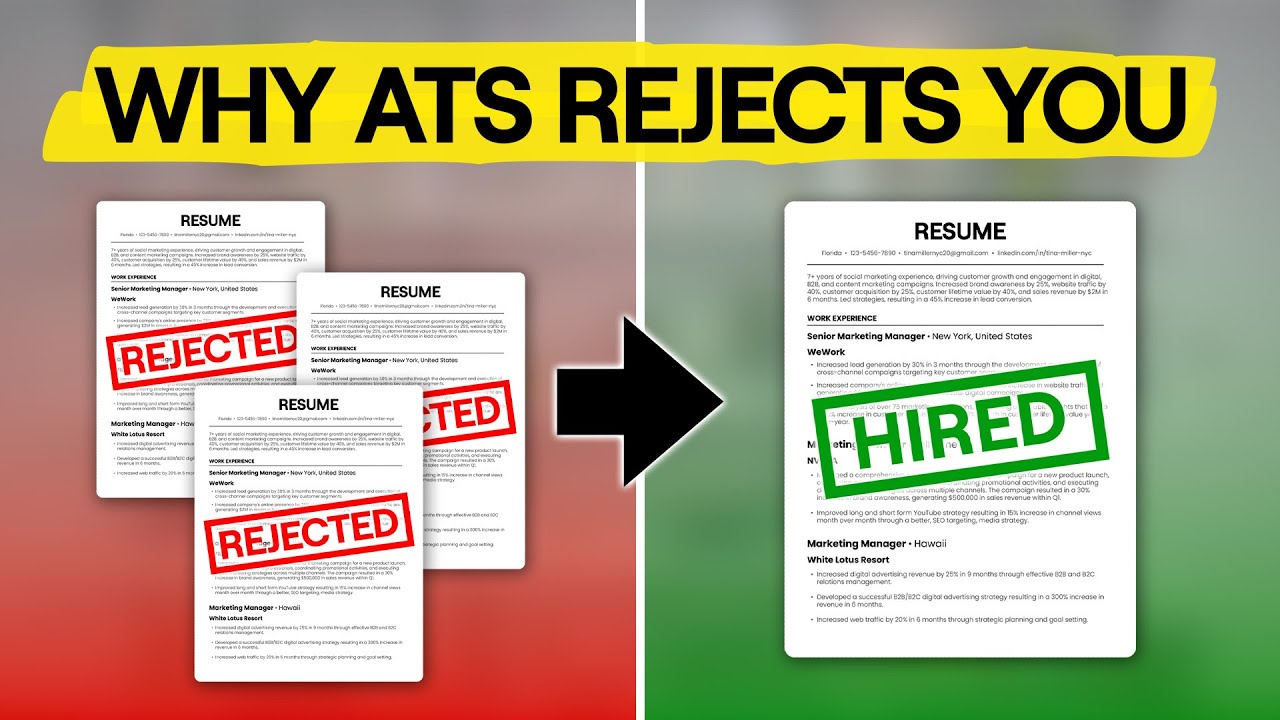
Article
Read the full piece
Your CV Looks Perfect—So Why Is the ATS Rejecting It?
You spent hours working on your CV.
You selected a professional design.
You used attractive colours.
You carefully arranged the sections.
You added impressive graphics.
You checked the spelling.
You saved the document.
You looked at it one final time and thought:
“This is perfect.”
Then you submitted it.
Days passed.
Weeks passed.
Still no interview.
No call.
No positive response.
And suddenly, a frustrating question begins to grow in your mind:
“If my CV looks so good, why am I not getting interviews?”
Here is the uncomfortable truth:
“A CV can look perfect to you and still perform poorly in a modern recruitment process.”
The problem may not always be your qualifications.
It may not be your experience.
It may not even be your skills.
Sometimes, the problem is that your CV is not communicating those strengths clearly to the recruitment technology and people involved in the hiring process.
Welcome to the world of Applicant Tracking Systems (ATS).
Looking Good and Working Well Are Not the Same Thing
One of the biggest mistakes job seekers make is judging their CV only by appearance.
They ask:
Does it look beautiful?
Are the colours attractive?
Is the design modern?
Does it stand out visually?
These questions are not completely wrong.
Professional presentation matters.
But there is a more important question:
Can the employer and their recruitment system easily understand my qualifications?
A beautiful CV that hides your skills is weaker than a simple CV that clearly communicates your value.
“Your CV is not competing in a beauty contest. It is competing for attention, relevance and opportunity.”
Modern recruitment requires your CV to do more than look impressive.
It needs to communicate.
First, Let's Clear Up One Important Myth
Many job seekers say:
“The ATS rejected my CV.”
But ATS systems do not all work in exactly the same way.
Different employers use different recruitment platforms and configure their hiring processes differently. Some systems help collect and organize applications, some parse CV information, and some support searching, filtering or matching candidates against job requirements. Human recruiters may also review applications as part of the process.
So instead of assuming there is one universal ATS robot automatically rejecting every imperfect CV, it is more useful to understand this:
Your CV may be processed, organized, searched or reviewed in a technology-supported recruitment environment.
That means clarity matters.
Structure matters.
Relevance matters.
And how you communicate your qualifications matters.
1. Your Beautiful Design May Be Hiding Important Information
A visually attractive CV can sometimes contain:
multiple columns
tables
graphics
icons
text boxes
skill bars
images
decorative layouts
These elements may look impressive to a human reader.
However, complex layouts can create difficulties for some resume-parsing systems. Resume parsing is used by many recruitment platforms to extract information such as employment history, education and skills from uploaded CVs.
Imagine spending ten years building valuable experience.
Now imagine that experience is placed in a section that is difficult to interpret correctly.
That is a problem.
“If your best qualifications are difficult to find, they may be difficult to evaluate.”
Your CV design should support your content—not compete with it.
2. Your CV Uses the Wrong Language
You may be highly qualified.
But are you describing your qualifications using clear and relevant professional language?
Consider this:
Your CV says:
Responsible for different project activities.
The job description emphasizes:
Project coordination
Stakeholder engagement
Monitoring and evaluation
Reporting
Your experience may actually match the role.
But your CV is not making that connection clear.
A stronger and more specific description could be:
Coordinated project activities, engaged key stakeholders, monitored implementation progress and prepared project reports.
Now your experience is easier to understand.
“Don't make employers guess what you can do. Show them.”
Recruitment systems and recruiters can search candidate information using relevant qualifications, skills and terminology. Some ATS tools also compare job-related keywords with information contained in candidate applications.
3. Your CV Is Too Generic
One CV.
One professional summary.
One skills section.
One application strategy.
Sent to fifty different employers.
This is one of the biggest mistakes in modern job searching.
A generic CV says:
“Here is everything I have ever done.”
A targeted CV says:
“Here is why my experience is relevant to this opportunity.”
That difference is powerful.
“A CV should not simply describe your past. It should connect your past to your next opportunity.”
Before applying, study the job description.
Identify the employer's priorities.
Then highlight the parts of your genuine experience that are most relevant.
Your career history does not change.
But your emphasis can change.
4. You Have the Right Skills—but They Are Hidden
This is one of the most frustrating problems.
You may actually possess the exact skills the employer needs.
But your CV does not clearly show them.
Imagine the employer is looking for:
Financial Reporting
Your CV says:
Handled financial activities.
That is vague.
What financial activities?
Reporting?
Budgeting?
Reconciliation?
Tax compliance?
Financial analysis?
The recruiter should not have to investigate your CV to discover your strengths.
If accurate, communicate your experience clearly:
Prepared financial reports, supported budget monitoring and performed account reconciliations.
Now your skills are visible.
Visibility is part of employability.
“You cannot expect employers to recognize qualifications you have failed to communicate.”
5. Your Professional Summary Is Saying Nothing
Your professional summary is valuable space.
But many job seekers waste it.
For example:
I am a hardworking, motivated and dedicated individual seeking an opportunity to grow professionally.
There is nothing wrong with wanting professional growth.
But this statement does not tell the employer:
What you do
What you specialize in
What skills you possess
What experience you bring
A stronger summary could be:
Results-driven finance professional with experience in financial reporting, budget monitoring, account reconciliation, tax compliance and financial records management.
Immediately, the employer understands your professional identity.
“Your CV should introduce your value before the recruiter has to search for it.”
6. You Focus on Duties Instead of Achievements
Many CVs are simply copies of job descriptions.
They say:
Responsible for...
Responsible for...
Responsible for...
Responsible for...
But employers want more.
They want to understand:
What did you achieve?
Compare:
Weak:
Responsible for preparing reports.
Stronger:
Prepared monthly operational reports to support management decision-making and performance monitoring.
Even stronger, where supported by genuine evidence:
Prepared monthly operational reports that improved reporting turnaround time by 25%.
The difference is clear.
The first describes a duty.
The second explains contribution.
The third demonstrates measurable impact.
“Responsibilities tell employers what you were asked to do. Achievements help show what you delivered.”
7. Your Keywords Are Missing—or Being Misused
Keywords can be important.
But keyword stuffing is not a strategy.
Your CV should never look like this:
Project management, project management, project management, reporting, reporting, reporting, stakeholder engagement...
That does not demonstrate experience.
It creates noise.
Instead, integrate relevant terminology naturally into meaningful statements.
For example:
Coordinated project implementation, engaged stakeholders, monitored performance indicators and prepared progress reports.
That is stronger because it connects your skills to real professional activity.
Some recruitment systems can compare candidate information with job-related keywords or use searchable candidate records to help identify potential matches.
“Keywords open doors only when your experience gives them meaning.”
8. Your CV Looks Professional—but It Is Not Relevant
This is a painful truth.
A perfectly formatted CV can still be a weak application.
Why?
Because the employer is not hiring your formatting.
They are hiring your ability to perform the role.
You could have:
Perfect spacing
Beautiful fonts
Excellent colours
Professional headings
But if your CV does not demonstrate relevant:
Skills
Experience
Qualifications
Achievements
then appearance alone cannot carry your application.
“A beautiful CV without relevance is like a beautiful advertisement for the wrong product.”
The best CV is not simply attractive.
It is strategic.
9. You Are Trying to Impress Everyone
One of the biggest problems with traditional CV writing is trying to include everything.
Every job.
Every responsibility.
Every training.
Every skill.
Every achievement.
The result?
A long document where your strongest qualifications are buried.
Modern employers often need to understand your relevance quickly.
So ask yourself:
What information matters most for this role?
Bring that information forward.
Your CV should not be a storage room for your entire career.
“Your CV is not your biography. It is your professional marketing document.”
10. Your CV Is Not Easy to Scan
Your CV may contain excellent information.
But can someone find it quickly?
Recruiters may need to identify relevant qualifications efficiently.
That means your CV should have:
Clear section headings
Logical organization
Relevant skills
Consistent dates
Clearly stated job titles
Concise achievement statements
Professional formatting
Standard sections such as Professional Experience, Education, Skills and Certifications can make information easier to locate and understand. Resume parsing systems are designed to extract and categorize information from uploaded CVs, while clear organization can also help human reviewers find relevant details faster.
“If your CV requires too much effort to understand, it is asking too much from a busy recruiter.”
The Real Reason Your CV May Be Failing
Your CV may not actually be failing because you are unqualified.
It may be failing because there is a communication gap.
There is a gap between:
What you can do
and
What your CV successfully communicates.
That gap can cost opportunities.
Think about it:
You may have excellent skills.
But if they are vague, they are difficult to evaluate.
You may have valuable experience.
But if it is poorly organized, it is difficult to find.
You may have remarkable achievements.
But if you only list responsibilities, they remain invisible.
“Your qualifications create your potential. Your CV communicates that potential.”
The Two Tests Your CV Must Pass
A modern CV should be prepared for two important audiences.
TEST ONE: TECHNOLOGY
Your CV should be:
Clearly structured
Easy to process
Organized logically
Written using relevant terminology
Free from unnecessary complexity
TEST TWO: PEOPLE
Your CV should also be:
Professional
Persuasive
Achievement-focused
Relevant
Easy to scan
Accurate
This creates the modern CV formula:
CLEAR FOR SYSTEMS + COMPELLING FOR RECRUITERS
That is the balance every job seeker should aim for.
Stop Asking, “Does My CV Look Good?”
Start asking better questions.
Ask:
Does my CV clearly show what I can do?
Does it match the position I am applying for?
Are my strongest skills easy to find?
Have I demonstrated achievements?
Am I using relevant professional language?
Is the information clearly structured?
Can a recruiter quickly understand my value?
These questions are far more important than:
“Do I like the colours?”
Before You Apply, Test Your CV
One of the smartest things a job seeker can do is stop submitting applications blindly.
Before clicking “Submit,” review your CV.
Check:
✓ ATS readability
✓ Relevant keywords
✓ Job alignment
✓ Skills visibility
✓ Achievement statements
✓ Professional structure
✓ Overall clarity
Don't guess. Check first.
This is where Smart CV Checker can become part of your job-search strategy.
Use Smart CV Checker Before Your Next Application
Your CV may look perfect.
But is it strategically prepared for the job you want?
Before submitting your next application, visit:
www.smartcvchecker.com
Use Smart CV Checker to review your CV and identify areas that may need improvement.
Because sometimes, the issue is not that your CV looks bad.
The issue is that your CV is not communicating your professional value effectively enough.
“The smartest job seekers don't just write a CV. They review, improve and test it before applying.”
The Smart Job Seeker's Formula
ANALYZE THE JOB
↓
TAILOR YOUR CV
↓
USE RELEVANT LANGUAGE
↓
SHOW REAL ACHIEVEMENTS
↓
CHECK THE STRUCTURE
↓
REVIEW YOUR CV
↓
APPLY WITH CONFIDENCE
This is a smarter approach to modern job searching.
Final Thoughts
Your CV may genuinely look perfect.
It may have an excellent design.
It may have beautiful formatting.
It may even impress your friends and colleagues.
But the most important question remains:
Is it working?
Because in the modern job market:
“A CV is only successful when it clearly communicates your value to the right opportunity.”
Don't focus only on making your CV beautiful.
Make it:
Relevant.
Clear.
Strategic.
Achievement-focused.
Professionally structured.
Easy to understand.
And most importantly:
Don't submit blindly.
Before your next application:
CHECK IT. IMPROVE IT. TAILOR IT. APPLY WITH CONFIDENCE.
Visit www.smartcvchecker.com and take a smarter approach to preparing your CV.
Your qualifications may already be strong.
Your experience may already be valuable.
Your skills may already be impressive.
Now make sure your CV gives them the visibility they deserve.
More from the journal
Related reading

10 African Careers That Could Grow Rapidly Before 2030

The Certificate Economy: Why More Qualifications Don't Always Mean a Better Career