
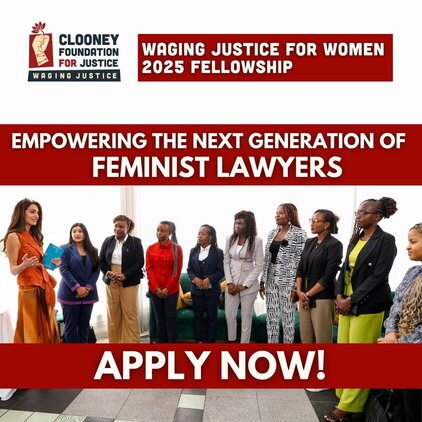
About the opportunity
What this programme is offering
he one-year fellowship supports 10 early-career African women lawyers by placing them with leading human rights and justice organizations in Kenya, Malawi, South Africa and The Gambia.
Fellows work directly on legal matters affecting women and children, including gender-based violence, child marriage and other violations of women's and girls' rights.
The programme provides practical legal experience, mentorship, training and access to a regional and global network of human rights experts.
📅 Application Deadline
20 October 2026
Applications for the 2027 cohort opened on 8 September 2026.
Selected fellows are expected to begin their placements in January 2027, with the fellowship running for one year through December 2027.
👩⚖️ Who Can Apply?
Applicants must:
Be a woman lawyer
Hold a law degree from a recognized academic institution
Be admitted to practice law in the jurisdiction relevant to the host organization
Have up to five years of relevant legal experience after graduating from law school or qualifying as a lawyer
Have the legal right to work in the relevant host country
Demonstrate a commitment to justice and human rights
Have strong legal research, writing, communication and analytical skills
Be able to work effectively with others and demonstrate initiative
Be willing to travel
Have fluency in English
Experience working on women's rights, human rights, vulnerable communities, survivors of violence or child marriage is particularly valuable.
⚠️ Important Work-Authorization Requirement
Applicants must already have the right to work in the country of the relevant host organization.
International relocation and obtaining work authorization are not supported by the programme.
Therefore, simply being an African lawyer is not enough; applicants need the appropriate right to work in the relevant host country.
🌍 2027 Host Countries
The 2027 fellowship placements are in:
🇰🇪 Kenya
🇲🇼 Malawi
🇿🇦 South Africa
🇬🇲 The Gambia
The current official list of 2027 host organizations includes organizations such as Katiba Institute in Kenya, Women Lawyers Association and CHREAA in Malawi, the Centre for Human Rights at the University of Pretoria in South Africa, and Female Lawyers Association Gambia and IHRDA in The Gambia.
💼 What Does the Fellowship Offer?
💰 Paid Work Placement
Fellows receive a competitive gross annual salary in the local currency from their host organization.
Additional travel or work-related expenses may be covered at the discretion of CFJ and/or the host organization.
⚖️ Practical Legal Experience
Fellows become embedded in their host organization for the entire year and contribute to its litigation and legal advocacy work concerning women and children's rights.
Their responsibilities can include:
Legal research
Legal drafting
Client support
Legal representation
Strategic litigation
Advocacy
Fact-finding
Supporting survivors and affected communities
CFJ also highlights the use of innovative technology to increase access to justice.
🎓 Mentorship & Training
Fellows receive:
Mentorship from CFJ programme leadership
Supervision from their host organizations
Monthly online training
At least one in-person convening
Access to leading lawyers, judges, activists and academics
A professional network of African and international human rights experts
After completing the fellowship, fellows join the CFJ Fellowship Alumni Network for continued professional development, collaboration and knowledge sharing.
👩⚖️ What Kind of Work Will Fellows Do?
The fellowship focuses particularly on advancing justice for women and children.
Possible areas include:
Gender-based violence
Child marriage
Women's rights
Children's rights
Strategic litigation
Legal aid
Human rights advocacy
Legal reform
Access to justice
Reproductive rights
Protection of vulnerable communities
How to apply