
About the opportunity
What this programme is offering
The self-guided course provides participants with a flexible way to build practical knowledge of sustainability, environmental protection, social inclusion and climate resilience.
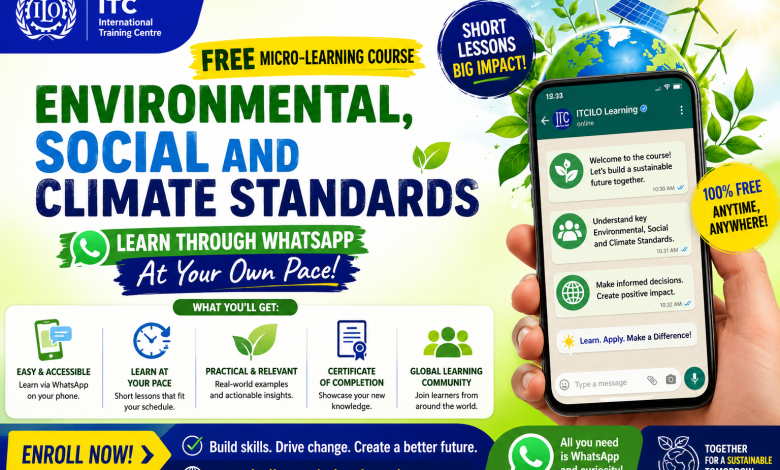
Unlike conventional online courses that require participants to sit through lengthy lectures, this micro-learning programme is designed for convenient learning directly through WhatsApp. Participants can access bite-sized learning content from their phones and progress at their own pace.
Course Overview
The free ITCILO micro-learning course focuses on the growing importance of environmental, social and climate considerations in investment projects, particularly those connected to agriculture and rural development.
The programme explores how sustainable development approaches can help address major global challenges, including climate change, ecosystem degradation and social inequalities.
Participants will be introduced to tools and frameworks designed to support more equitable, socially inclusive and environmentally sustainable projects.
The course is delivered in English and is self-guided, making it suitable for professionals and learners who want to develop their understanding of environmental and social standards without committing to a fixed classroom schedule.
What Makes This Course Different?
One of the most distinctive features of the programme is its WhatsApp-based learning format.
Participants receive short, engaging pieces of content—or “pills”—that encourage reflection and discussion around environmental, social and climate standards. The format is designed to make learning accessible anytime and anywhere.
The course also incorporates AI support through an intelligent chatbot, providing tailored assistance as participants work through the learning materials.
This combination of mobile learning, bite-sized content and AI assistance makes the programme particularly useful for busy professionals seeking flexible professional development.
Who Can Take the Course?
The programme is designed for a broad audience interested in environmental, social and climate standards and their application to sustainable development projects.
Potential participants include:
Project Management Unit staff
Senior government officials involved in project oversight
National staff from ministries of agriculture, environment and other relevant sectors
Environmental, social and climate regulatory bodies
Environmental, social and climate consultants
Contractors
Professionals involved in non-sovereign operations
Individuals interested in sustainable agriculture and rural development
The course may also appeal to students, development practitioners, researchers and professionals looking to strengthen their understanding of sustainability frameworks.
What Will Participants Learn?
The programme introduces participants to Environmental, Social and Climate Standards (SECAP) and their role in promoting sustainability, equity and resilience in investment projects.
The ten learning pillars cover:
Introduction to SECAP
Biodiversity Conservation
Resource Efficiency and Pollution Prevention
Cultural Heritage
Indigenous Peoples
Labor and Working Conditions
Community Health and Safety
Physical and Economic Resettlement
Financial Intermediaries and Direct Investments
Climate Change
These topics provide participants with a broad understanding of how environmental and social considerations can be incorporated into development and investment projects.
Practical Skills and Knowledge
At the end of the micro-learning programme, participants should have a stronger ability to engage in conversations about sustainability and development and understand how Environmental, Social and Climate Standards can be applied in real-world projects.
The course is also designed to help participants:
Identify sustainability considerations in development projects
Understand biodiversity conservation requirements
Explore approaches to pollution prevention and resource efficiency
Recognise the importance of cultural heritage and Indigenous Peoples’ rights
Understand labor and working-condition standards
Consider community health and safety
Understand issues surrounding physical and economic resettlement
Explore the relationship between financial intermediaries and sustainability
Consider climate change in investment and development decisions
Use relevant tools and frameworks to support sustainable initiatives
The programme also highlights the importance of partnerships and knowledge exchange in advancing environmental and social sustainability.
Earn Badges as You Learn
The course provides an additional incentive for participants to complete the learning journey.
Participants can earn a badge for each learning pill completed, with 10 badges available in total.
This gamified approach allows learners to track their progress while working through the different Environmental, Social and Climate Standards.
Why Consider This Free Course?
There are several reasons professionals and aspiring development practitioners may find this opportunity valuable.
It is free: Participants can access the micro-learning without paying a course fee.
It is flexible: The self-guided structure allows participants to learn at their own pace.
It is mobile-friendly: Learning takes place through WhatsApp, allowing participants to access content directly from their phones.
It covers important development issues: Environmental sustainability, climate change, social inclusion, labor conditions and community safety are increasingly important across development projects.
It includes AI support: Participants can receive assistance through an intelligent chatbot during their learning journey.
It provides practical knowledge: Rather than focusing solely on theory, the course connects environmental, social and climate standards to real-world investment and development projects.
How to Apply for the Free ITCILO Course
There is no conventional application process described for this micro-learning programme. Interested individuals can join directly through the course’s WhatsApp access link.
Participants can also use the QR code provided on the official ITCILO course page to open WhatsApp and begin the learning journey.
How to apply