
About the opportunity
What this programme is offering
Generator Residency 2027 in the USA: Earn $8,500 Monthly to Build AI Safety Projects in Berkeley
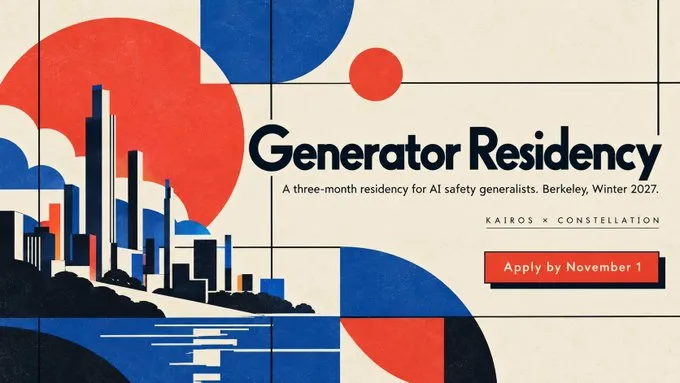
Professionals interested in shaping the future of artificial intelligence have an exciting opportunity to develop practical projects, receive expert mentorship and earn US$8,500 per month through the Generator Residency Winter 2027 in Berkeley, California, USA.
Organised by Kairos and Constellation, the three-month residency is designed for ambitious individuals who want to contribute to making advanced artificial intelligence safer and more beneficial to humanity.
Unlike programmes focused exclusively on technical AI research, Generator welcomes professionals from different backgrounds, including operations, communications, public policy, engineering, computer science and programme management.
Applications are open to candidates worldwide, with the deadline set for 1 November 2026.
About the Generator Residency 2027
The Generator Residency is a three-month programme that helps participants identify gaps in the AI safety ecosystem, develop practical solutions and deliver projects that address important challenges in the field.
The programme is intended for AI safety generalists—people who can organise initiatives, coordinate teams, build networks, manage projects and turn promising ideas into practical results.
Residents will work with experienced professionals, receive mentorship and gain exposure to organisations operating within the AI safety ecosystem.
Programme overview
Programme: Generator Residency Winter 2027
Organisers: Kairos and Constellation
Location: Berkeley, California, USA
Duration: Three months
Programme dates: 18 January – 9 April 2027
Monthly stipend: US$8,500
Travel: Covered to and from Berkeley
Application deadline: 1 November 2026
Eligibility: Applicants from anywhere in the world
Benefits of the Generator Residency
1. Monthly stipend of US$8,500
Selected participants receive a fellowship stipend of US$8,500 per month during the core residency. This represents US$25,500 over three months for participants receiving all three monthly payments.
Some participants on the Embedded Track may instead be employed during the residency at a roughly equivalent gross salary.
2. Travel support
Kairos covers travel to and from Berkeley, helping selected international participants attend the in-person programme.
3. Expert mentorship
Residents receive weekly guidance from experienced AI safety professionals and generalists. This provides an opportunity to learn from people working across different organisations and areas of the sector.
4. Project funding
Participants receive project budgets to support implementation. Eligible expenses may include venues, contractors, tools and travel.
5. Professional networking and career development
Residents gain access to the Constellation coworking office, including meals on working days, and opportunities to build relationships with professionals across the AI safety ecosystem.
The programme also supports participants seeking full-time careers in the field, including roles in programme management, operations, policy, organisational development and field-building.
Who Can Apply?
The residency welcomes early-career and mid-career professionals from different academic and professional backgrounds.
Relevant areas of experience include:
Operations and project management.
Communications and public engagement.
Public policy and governance.
Engineering and computer science.
Programme coordination.
Organisational development.
Other professional fields relevant to AI safety.
The organisers are particularly interested in applicants who demonstrate:
A strong record of getting things done and delivering results.
Initiative and the ability to identify problems and develop solutions.
Comfort working in fast-changing and uncertain environments.
Genuine commitment to ensuring that transformative AI benefits humanity.
Applicants do not need to be technical AI researchers. The programme is primarily designed for builders, operators and organisers who want to contribute through practical project execution.
Two Tracks Available
Applicants can explore two pathways depending on their interests and experience.
1. Self-Directed Track
Participants develop and lead their own projects, sometimes working with other residents. This track is suitable for people with a strong project vision who want to take an initiative from planning through implementation.
Possible projects include organising AI safety conferences, developing talent programmes, creating community infrastructure and establishing new initiatives that address gaps in the sector.
2. Embedded Track
Participants work with an existing AI safety organisation or closely alongside an experienced mentor. Projects are developed in collaboration with the organisation or mentor.
This pathway is suitable for individuals who want to gain practical experience, learn from established professionals and build relationships within an AI safety organisation.
Programme Structure and Timeline
The core residency runs for 12 weeks, from 18 January to 9 April 2027.
The programme is organised around three main stages:
Project scoping – Weeks 1–2: Participants build their understanding of the AI safety ecosystem, meet potential mentors and identify projects or organisations to work with.
Project execution – Weeks 3–12: Residents implement their projects individually or in teams, with mentorship and project budgets.
Transition or extension – Week 13 onwards: Participants receive support to pursue full-time roles, establish new organisations or transfer their projects to existing organisations.
Selected residents may also be invited to a funded three-month extension, with in-person participation in Berkeley until late May and remote participation afterwards until early July 2027.
Can International Applicants Apply?
Yes. The programme welcomes applications from anywhere in the world, including candidates outside the United States.
For most international applicants, the organisers can sponsor J-1 visas for the duration of the programme, although visa approval is not guaranteed.
Because visa processing takes time, international candidates who require sponsorship are strongly encouraged to apply early.
Application Process
Interested candidates should apply through the official Generator Residency application portal.
The selection process includes three stages:
Initial application review: Applications are assessed by the programme team.
Work test: Shortlisted candidates may receive a work test lasting approximately two hours. These are expected to be sent by 9 November 2026.
Interview: Candidates who progress will be invited to a short interview, expected to take place in mid-November.
Final application decisions are expected by 25 November 2026.
Important application instruction: Applicants must write all free-response answers themselves. The organisers explicitly prohibit using AI tools to write, rewrite, polish or translate application responses. Applications containing AI-written answers may be rejected. The organisers also ask applicants to include the word “collate” at least once in their written answers.
Application Deadline
The deadline for the Generator Residency Winter 2027 is 1 November 2026, at the end of the day, Anywhere on Earth (AoE).
International applicants requiring visa sponsorship should apply as early as possible to allow time for processing.
How to Apply
Visit the official programme website to review the complete requirements and submit your application:
Official website: https://generatorresidency.org/
Application portal: https://forms.kairos-project.org/
Final Thoughts
The Generator Residency offers an alternative pathway into the artificial intelligence safety sector for professionals who may not have a technical research background but possess valuable skills in communication, coordination, policy, operations and project development.
With a monthly stipend of US$8,500, travel support, project funding and access to experienced mentors, the programme provides an opportunity to gain practical experience while contributing to the responsible development of advanced AI systems.
Eligible professionals interested in building a career in AI safety should review the application requirements and submit their applications before the deadline.
How to apply