
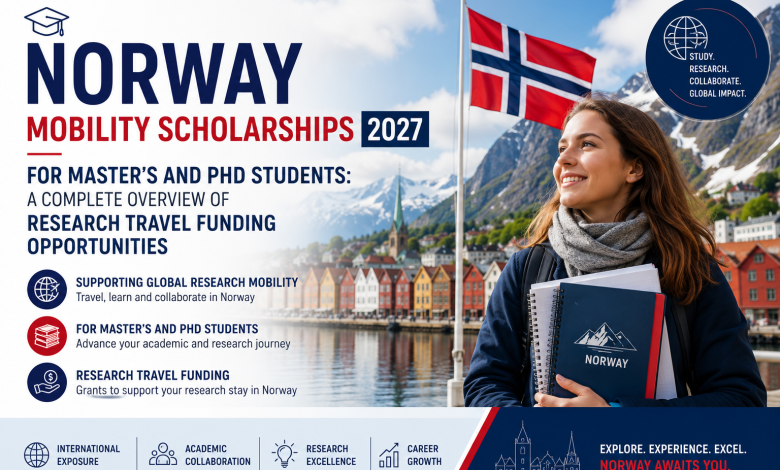
About the opportunity
What this programme is offering
These programmes are part of Norway’s broader strategy to strengthen academic partnerships, increase research quality, and promote global knowledge exchange.
Unlike full degree scholarships, most Norway mobility scholarships are short-term funding opportunities that support travel, living costs, and research stays abroad or in Norway for Master’s and PhD candidates.
What Are Norway Mobility Scholarships?
Norway mobility scholarships are funding schemes offered by universities, government agencies, and international programmes to support academic movement between institutions and countries. They are primarily designed for:
Master’s students conducting thesis-related research abroad or in Norway
PhD candidates undertaking research stays or fieldwork
Early-career researchers engaged in collaborative projects
Students involved in Nordic, European, or global exchange programmes
These scholarships are commonly linked to research development, academic networking, and thesis completion rather than full degree tuition coverage.
Key Norway Mobility Funding Programmes for 2027
Several established schemes are expected to continue into 2027, including institutional grants and international mobility initiatives.
Erasmus+ Global Mobility (KA171)
The Erasmus+ Global Mobility scheme allows Master’s and PhD students to conduct academic exchange or research stays outside their home country, including partnerships involving Norway.
Key features include:
Duration: 2 to 12 months depending on programme type
Funding support for travel and living expenses
Academic exchange between partner universities
Focus on international collaboration and skills development.
Research Council of Norway Mobility Grants
The Research Council of Norway (Norges forskningsråd) supports research mobility for PhD candidates and postdoctoral researchers through project-linked funding schemes.
These grants typically:
Fund research stays abroad or in Norwegian institutions
Support collaboration with international research groups
Strengthen PhD dissertation outcomes and publication output
Require supervisor-approved research plans
Such funding is highly competitive and usually tied to ongoing research projects.
University-Based Mobility Grants
Norwegian universities also provide internal mobility funding for PhD and Master’s students. For example, institutions may offer:
Short-term research stay grants (3–6 months)
Conference and fieldwork travel support
International collaboration funding
Some universities open annual calls for 2027 mobility stays, often prioritizing doctoral candidates and early-stage researchers.
MSCA and Horizon Europe Mobility Fellowships
Norwegian institutions also participate in the European Union’s Marie Skłodowska-Curie Actions (MSCA), which fund international research mobility.
Education
Key features:
Open to PhD holders and early-career researchers
Funding for 12–24 month international research stays
Strong emphasis on interdisciplinary and cross-border research
Includes both European and global mobility options
These fellowships are among the most prestigious research mobility schemes in Europe.
Fulbright and Arctic Research Scholarships
For Norwegian and international researchers, additional mobility funding includes:
Fulbright grants for study or research between Norway and the United States
Arctic-focused scholarships supporting polar and environmental research
Short-term fieldwork grants for Master’s and PhD students
Typical Funding Coverage
Most Norway mobility scholarships are designed to cover partial or full expenses related to research travel.
Common financial support includes:
Airfare and international travel costs
Monthly living allowance during the research stay
Accommodation support
Research-related expenses (in some cases
Eligibility Requirements
Eligibility depends on the specific programme, but general requirements include:
Enrollment in a Master’s or PhD programme
Strong academic performance
Approved research plan or thesis proposal
Institutional affiliation with a Norwegian or partner university
Supervisor recommendation or departmental approval
Some schemes may also prioritize:
Early-career researchers
Students in priority disciplines (e.g., climate, social sciences, engineering)
Applicants with international collaboration projects
How to apply