
About the opportunity
What this programme is offering
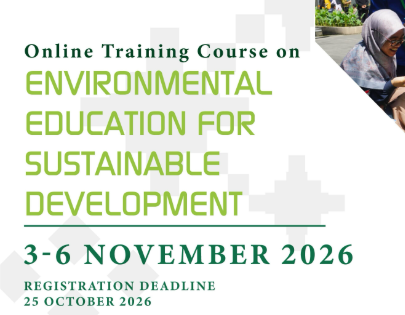
Regional Training Course on Environmental Education for Sustainable Development (EESD) 2026: Online Training for Science Teachers
Science teachers interested in climate change, biodiversity conservation, and sustainable development have an opportunity to strengthen their teaching skills through the Regional Training Course on Environmental Education for Sustainable Development (EESD) 2026.
Promoted by the Southeast Asian Ministers of Education Organization Regional Centre for Quality Improvement of Teachers and Education Personnel in Science (SEAQIS), this online professional development programme aims to help educators integrate environmental sustainability into classroom teaching and learning.
The training is scheduled for 3–6 November 2026 and is designed for science teachers seeking practical approaches to environmental education. Participants will have an opportunity to explore how environmental challenges can be transformed into engaging learning experiences that encourage critical thinking, problem-solving, and responsible action.
Teachers interested in strengthening environmental awareness among learners should review the official registration information to confirm eligibility and participation requirements.
EESD Regional Training Course 2026: Key Details
Programme: Regional Training Course on Environmental Education for Sustainable Development (EESD)
Organiser: SEAQIS
Target audience: Science teachers
Dates: 3–6 November 2026
Format: Online
Key themes: Climate change, biodiversity conservation, environmental awareness, and sustainability
Registration link: https://bit.ly/EESD_SEAQIS2026
Registration deadline: Check the official registration page for the applicable deadline and current registration status.
As the training dates approach, interested teachers should check the registration page promptly to establish whether applications are still being accepted and whether any additional participation conditions apply.
About Environmental Education for Sustainable Development
Environmental challenges such as climate change, biodiversity loss, pollution, and resource depletion affect communities across the world. Their consequences can be seen in agriculture, public health, water availability, food security, ecosystems, and livelihoods.
Education plays an important role in helping young people understand these challenges and explore possible solutions.
Environmental Education for Sustainable Development (EESD) connects scientific knowledge with practical experiences. It encourages learners to investigate environmental problems, examine evidence, consider different perspectives, and identify responsible ways to respond.
For example, students studying climate change might explore local weather patterns, discuss renewable energy, or investigate ways to reduce waste and emissions. Lessons on biodiversity could involve observing local plants and animals, studying habitats, or examining the importance of protecting pollinators.
These approaches can make science lessons more relevant while developing critical thinking, collaboration, problem-solving, and environmental responsibility.
What Science Teachers Can Gain from the Training
1. Integrating Climate Change into Science Lessons
Climate change provides opportunities to connect scientific concepts with real-world experiences. Teachers can explore topics such as greenhouse gases, changing weather patterns, renewable energy, and climate adaptation through experiments, case studies, and project-based learning.
Environmental education training can help educators identify ways to make these subjects understandable and relevant to their students.
2. Promoting Biodiversity Conservation
Biodiversity supports healthy ecosystems, food production, clean water, and human well-being. However, habitat destruction, pollution, invasive species, and climate change threaten many plant and animal species.
Teachers can help learners understand these issues through nature observations, school gardens, local ecosystem studies, and species identification activities.
Connecting classroom learning to the surrounding environment can encourage students to appreciate biodiversity and understand the importance of conservation.
3. Making Sustainability Practical and Interactive
Students often understand sustainability more effectively when they can apply what they learn.
Practical classroom and school activities may include:
Conducting waste audits and recycling projects.
Promoting water conservation.
Introducing energy-saving initiatives.
Establishing or supporting environmental clubs.
Investigating environmental challenges within the school community.
Such activities help learners move beyond theoretical knowledge and recognise how everyday decisions can contribute to environmental protection.
4. Building Environmental Awareness and Responsibility
Teachers influence how young people understand their relationship with the natural world. Through inquiry, discussion, and participation, educators can help students develop a stronger sense of responsibility toward their communities and the environment.
Environmental education also provides opportunities to discuss sustainable consumption, responsible resource management, environmental fairness, and the connection between ecological protection and human well-being.
Who Should Register?
The training is promoted specifically for science teachers interested in strengthening their professional knowledge and integrating environmental sustainability into their teaching practices.
It may be particularly relevant to teachers who:
Teach biology, chemistry, physics, or integrated science.
Want to incorporate climate change and biodiversity into their lessons.
Use practical investigations and project-based learning.
Lead environmental clubs or school sustainability initiatives.
Seek professional development in environmental education and sustainable development.
Prospective participants should consult the official registration page to confirm the programme's eligibility criteria and any other requirements.
How to apply