
About the opportunity
What this programme is offering
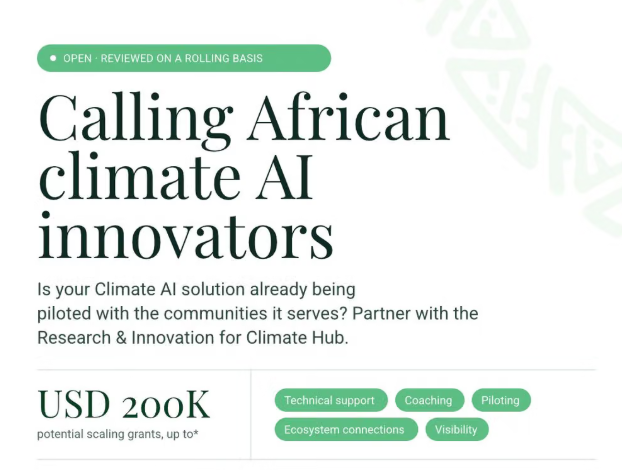
RICH Hub Climate AI Innovation 2026: African Innovators Can Explore Scaling Grants of Up to US$200,000
African climate innovators, researchers, startups, and organisations developing technology-based solutions to environmental challenges are invited to explore opportunities through the Research and Innovation for Climate (RICH) Hub Climate AI Innovation initiative.
The initiative focuses on using artificial intelligence (AI), data-driven technologies, and research to strengthen climate resilience across Africa. It seeks to support promising innovations that can help communities and institutions respond to climate change and environmental challenges.
According to the opportunity announcement, eligible innovations must have reached at least the pilot stage. This means the initiative is intended for solutions that have progressed beyond the idea stage and have demonstrated some level of development or testing.
Selected innovators may access technical assistance, coaching, research collaboration, piloting opportunities, professional networks, and partnerships to support further development. Eligible initiatives may also access potential scaling grants of up to US$200,000, subject to eligibility requirements and available resources.
Expressions of Interest are reportedly accepted on a rolling basis. Applicants should consult the official application form to confirm the current status of the opportunity and its requirements.
RICH Hub Climate AI Innovation 2026: Overview
Opportunity: RICH Hub Climate AI Innovation
Programme: AI4D Research and Innovation for Climate Hub
Focus areas: Climate AI, environmental innovation, climate resilience, and data-driven technologies
Geographic focus: Africa
Eligible applicants: African climate innovators, researchers, startups, and organisations
Required innovation stage: Pilot stage or beyond
Potential funding: Scaling grants of up to US$200,000
Additional support: Technical assistance, coaching, research collaboration, piloting, partnerships, and visibility
Application method: Online Expression of Interest
Deadline: Rolling basis, according to the supplied announcement
Application fee: Not specified in the supplied information
About the RICH Hub Climate AI Initiative
The Research and Innovation for Climate Hub seeks to strengthen the development and application of climate-focused AI and data-driven innovations across Africa.
Through the AI4D Research and Innovation for Climate initiative, innovators may have opportunities to connect their solutions with research expertise, technical support, and partnerships that can help address environmental challenges.
Across Africa, climate change contributes to challenges such as droughts, flooding, unpredictable rainfall, food insecurity, biodiversity loss, and pressure on natural resources.
Artificial intelligence and data-driven technologies can help communities, researchers, farmers, and institutions analyse climate information, improve risk forecasting, monitor environmental changes, and make better-informed decisions.
The initiative provides a potential pathway for innovators to test, improve, and scale practical solutions designed for African contexts.
Who Can Apply?
The opportunity is intended for African climate AI innovators, researchers, startups, and organisations developing solutions that address climate or environmental challenges.
Applicants should have an innovation that uses AI, data-driven technologies, or related approaches to strengthen climate resilience. The innovation must have reached the pilot stage or beyond.
Potential applicants include:
African startups developing AI-powered climate solutions.
Researchers working on climate modelling, environmental data, or adaptation technologies.
Technology organisations creating digital tools for climate resilience.
Innovation teams testing technology-based responses to environmental challenges.
Climate technology initiatives seeking technical assistance, research partnerships, or opportunities to scale their solutions.
The complete eligibility requirements, including any country-specific restrictions and organisational conditions, should be checked through the official Expression of Interest form.
Priority Areas and Potential Innovation Themes
Although the supplied announcement does not provide an exhaustive list of eligible sectors, several applications of climate AI may be relevant to the initiative.
1. Climate Risk and Early Warning Systems
AI-powered systems can analyse weather and environmental data to help identify potential droughts, floods, and other climate-related risks. Such tools may support early warning systems and improve preparedness among vulnerable communities.
2. Climate-Smart Agriculture
Data-driven technologies can help farmers make informed decisions about crop selection, irrigation, soil management, and changing weather patterns.
Solutions that improve agricultural productivity while helping farmers adapt to climate variability may offer practical benefits for food security.
3. Water Resource Management
Climate AI applications can support water monitoring, drought preparedness, and more efficient management of water resources.
These technologies may help communities and institutions respond to changing rainfall patterns and increasing pressure on water supplies.
4. Environmental Monitoring
AI tools can analyse environmental information to help monitor biodiversity, deforestation, ecosystem changes, and land degradation.
Such innovations may support conservation efforts and strengthen evidence-based environmental planning.
5. Climate Adaptation and Resilience
Digital tools can help communities, governments, and organisations understand climate risks, plan adaptation measures, and improve their responses to environmental challenges.
These themes are illustrative examples rather than confirmed exclusive funding categories. Applicants should establish whether their proposed solutions match the initiative's current priorities.
What Support Can Selected Innovators Receive?
The opportunity announcement identifies several potential forms of support for selected innovations.
Technical assistance: Support to improve or refine climate-focused technologies.
Coaching and guidance: Assistance with innovation development, implementation, and scaling.
Research collaboration: Potential opportunities to work with researchers and relevant institutions.
Piloting opportunities: Support for testing and demonstrating solutions in practical settings.
Ecosystem connections: Opportunities to connect with relevant stakeholders and innovation networks.
Visibility and partnerships: Potential exposure and connections that may support adoption and further development.
Potential scaling grants: Eligible innovations may access grants of up to US$200,000, subject to the programme's conditions and available resources.
The maximum grant amount is not guaranteed funding for every applicant. The supplied announcement does not establish standard award amounts, disbursement schedules, or detailed grant conditions.
How to Apply for RICH Hub Climate AI Innovation 2026
Interested applicants should submit an Expression of Interest through the official online application form.
Review the opportunity: Read the official announcement and understand the initiative's objectives.
Confirm eligibility: Check that your organisation, team, or research initiative meets the applicable requirements.
Describe the problem: Explain the climate or environmental challenge your innovation addresses and identify the intended beneficiaries.
Explain the technology: Describe how AI, data-driven technologies, or related approaches contribute to the proposed solution.
Demonstrate progress: Provide evidence of pilot implementation, testing, early results, or other development beyond the conceptual stage.
Explain the potential impact: Highlight the solution's relevance to African climate challenges, scalability, and expected benefits.
Submit the Expression of Interest: Complete the official form and follow the application instructions.
Applicants should confirm which supporting documents are required and whether additional assessments or selection stages apply.
Application Deadline
According to the supplied announcement, Expressions of Interest are accepted on a rolling basis, meaning no single fixed deadline is stated.
However, applicants should verify that submissions are currently being accepted and check whether any additional timelines or funding conditions apply.
Final Thoughts
The RICH Hub Climate AI Innovation initiative may offer a valuable opportunity for African innovators working at the intersection of artificial intelligence, environmental research, and climate resilience.
For startups, research teams, and organisations with solutions that have already reached the pilot stage, the opportunity could provide access to technical expertise, research partnerships, and potential scaling finance.
Applicants should focus on demonstrating the practical value of their innovations, evidence of progress, relevance to African climate challenges, and potential for wider adoption.
Before applying, verify the official call, eligibility requirements, and application form. The supplied announcement does not include a direct application link, so one should not be guessed.
How to apply