
About the opportunity
What this programme is offering
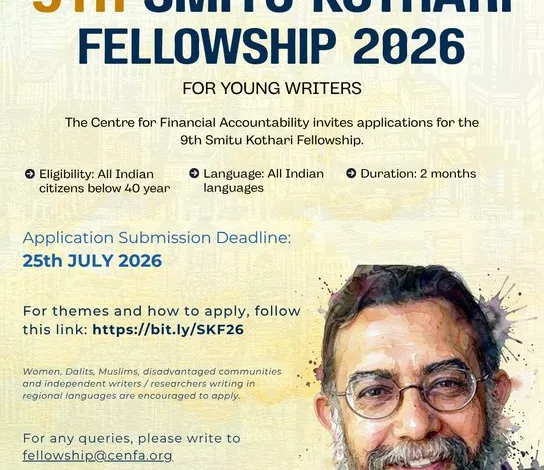
Now in its ninth year, the fellowship continues its mission of supporting critical, evidence-based storytelling on issues of financial accountability, democratic governance, environmental justice, and social equity. Inspired by the legacy of renowned environmentalist and scholar-activist Smitu Kothari, the programme encourages participants to challenge conventional narratives around development and investigate how finance influences people’s lives, livelihoods, and access to essential services.
Applications are open until 25 July 2026.
About the Smitu Kothari Fellowship
Launched in 2018, the Smitu Kothari Fellowship has provided emerging researchers and storytellers with opportunities to produce investigative work that explores the relationship between finance, governance, and social justice.
The 2026 edition focuses on the theme “Cities, Finance & the People,” reflecting the growing influence of public and private finance on India’s urban transformation.
As cities continue to expand through infrastructure investments, housing developments, and technological innovations, the fellowship seeks to answer critical questions:
Who benefits from urban growth?
Who bears the social and environmental costs?
Which communities remain excluded from development?
Through in-depth research and compelling storytelling, fellows will contribute to public understanding of the financial systems shaping India’s cities.
Fellowship Theme: Cities, Finance & the People
Participants are encouraged to investigate how financial mechanisms influence urban governance, infrastructure, housing, climate resilience, public services, and livelihoods.
Grants, Scholarships & Financial Aid
The fellowship welcomes proposals that highlight voices and experiences often overlooked in mainstream discussions on urban development.
Key Research Areas
Applicants may explore a wide range of topics, including:
Urban Finance and City Budgets
Potential areas include:
Municipal finance
City budgeting and fiscal priorities
Infrastructure financing
Municipal debt
Smart city financing models
Housing and Urban Displacement
Research topics may examine:
Real estate financing
Housing affordability
Forced evictions
Urban resettlement
Informal settlements
Land rights
Urban Commons and Inclusive Cities
Applicants can investigate issues relating to:
Public transport
Water resources
Parks and public spaces
Urban governance
Equity in service delivery
Inclusive urbanisation
Informal Economy
Possible focus areas include:
Street vendors
Gig economy workers
Informal labour markets
Financial inclusion
Access to insurance and credit
Urban policy impacts
Climate, Risk and Urban Inequality
Research proposals may cover:
Urban flooding
Drainage failures
Heat stress
Coastal vulnerability
Climate finance
Climate adaptation
Environmental justice
Digital Cities
Topics may include:
Surveillance technologies
Data governance
Fintech solutions
Digital public services
Privacy rights
Digital exclusion
Infrastructure Accountability
Applicants may investigate:
Infrastructure failures
Public procurement
Construction quality
Contract management
Cost overruns
Public accountability
Urban Governance
Suggested themes include:
The Right to the City
Citizen participation
Local governance
Urban decentralisation
Financial transparency
Governance reforms
Fellowship Benefits
Selected fellows will receive:
Grants, Scholarships & Financial Aid
A fellowship grant of ₹20,000
Two months of structured mentorship
Editorial guidance from experienced journalists and sector experts
Opportunities to publish investigative work
A platform to present research findings to the Centre for Financial Accountability
The fellowship will begin in August 2026 and run for two months.
Mentorship
Participants will receive mentorship from Rakesh Dewan, Senior Journalist and Editor of Sarvodaya Press Service, who has previously held senior editorial positions at Dainik Bhaskar, Tehelka, and other leading publications.
In addition, fellows will benefit from thematic guidance provided by sector-specific experts throughout the programme.
Eligibility Criteria
The fellowship is open to:
Indian citizens below the age of 40 years
Writers working in English or any Indian language
Journalists
Researchers
Independent writers
Visual storytellers
The Centre particularly encourages applications from:
Women
Dalit communities
Muslim communities
Other disadvantaged groups
Regional language writers and researchers
Application Requirements
Applicants are required to submit their applications through the official online application form.
Each application should include a research proposal or story idea outlining:
Tentative title
Research focus
Key questions to be explored
Proposed storytelling approach
Applicants wishing to submit multiple proposals may complete the application form more than once.
Fellowship Deliverables
Selected fellows will be expected to produce one of the following:
Grants, Scholarships & Financial Aid
A comprehensive analytical article of 1,000–1,500 words, or
A photo essay, or
A short documentary based on the approved proposal
In addition, fellows will:
Seek publication of their work in mainstream media after receiving CFA approval
Present their findings to the Centre upon completion of the fellowship
Authors will retain copyright ownership of their work, while CFA reserves the right to publish and translate the material with appropriate attribution.
Important Dates
Prospective applicants should note the following timeline:
Application deadline: 25 July 2026
Selection announcement: 5 August 2026
Submission of final work: 15 October 2026
Publication deadline: By 30 November 2026
Why Apply?
The Smitu Kothari Fellowship provides an excellent platform for emerging journalists, writers, and researchers to investigate pressing issues affecting India’s cities while strengthening their investigative, analytical, and storytelling skills.
Beyond financial support, participants gain expert mentorship, publication opportunities, and the chance to contribute meaningful public discourse on urban governance, financial accountability, environmental justice, and inclusive development.
Young professionals committed to producing impactful public-interest journalism and research are encouraged to submit their applications before the 25 July 2026 deadline
How to apply