
About the opportunity
What this programme is offering
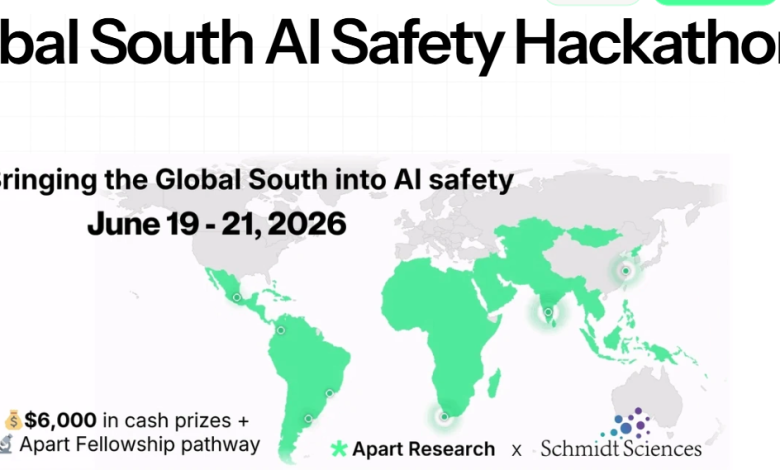
Apart Research, with support from Schmidt Sciences, has announced the Global South AI Safety Hackathon, a regional initiative designed to broaden participation in artificial intelligence safety research across Latin America, Africa, and Asia.
Global South opportunities
The programme aims to address the global concentration of AI safety research in a small number of countries by enabling researchers from underrepresented regions to contribute directly to technical, policy, and governance solutions.
The hackathon is currently open for registration, with 21 days remaining and over 148 participants already signed up.
Overview of the Global South AI Safety Hackathon
The Global South AI Safety Hackathon is a weekend-based collaborative research event that brings together engineers, researchers, students, and policy professionals from across the Global South. Participants work in teams to develop tools, evaluation frameworks, and policy research addressing AI safety challenges that are often overlooked in mainstream global AI governance discussions.
The programme is explicitly structured to ensure regional participation, with teams competing within their respective regions rather than on a global leaderboard. This regional approach is intended to highlight local priorities and ensure that AI safety solutions are contextually relevant.
The initiative is designed as part of a broader pipeline that may lead participants from hackathon participation to longer-term fellowships and research placements.
Purpose and Rationale for Regional Focus
Organisers of the hackathon highlight the imbalance in global AI safety research, noting that most leading institutions in the field are based in a small number of countries. This concentration has contributed to gaps in understanding how AI systems affect regions in the Global South.
The programme emphasizes that AI risks are not uniform globally. In many countries across Africa, Asia, and Latin America, AI systems behave differently due to linguistic diversity, infrastructure constraints, and local regulatory environments.
Key challenges identified include:
Higher rates of jailbreak and misuse in low-resource languages
Algorithmic bias resulting from non-local training data
Limited transferability of existing AI safety benchmarks
Differences in regulatory capacity and enforcement
Dependence on foreign AI infrastructure and compute resources
The hackathon aims to bridge these gaps by leveraging local expertise and contextual knowledge from researchers in affected regions.
Regional Tracks and Competition Structure
The hackathon is divided into three major regional tracks, each with its own hubs, thematic focus, and prize structure.
Latin America Track
This track includes hubs in São Paulo, Buenos Aires, Bogotá, Mérida, Guadalajara, and Santa Cruz. The region will award prizes totalling approximately 3,000 USD.
Participants in this track focus on both technical and policy-oriented AI safety challenges, including:
AI fairness in Spanish and Portuguese language models
Regulatory analysis of emerging AI legislation
Evaluation of regional AI governance frameworks
Policy alignment with national AI strategies
The track is informed by ongoing legislative developments such as Brazil’s AI bill (PL 2.338/2023), Chile’s constitutional neuro-rights protections, and Colombia’s national AI policy framework.
Africa Track
The Africa track includes hubs in Cape Town, Tanzania, and Zimbabwe, with one winning team receiving a total prize of 1,000 USD.
This track focuses on deployment-side AI risks rather than frontier model development. It addresses issues such as:
Deepfake-driven electoral interference
Data colonialism and infrastructure dependence
Limited compute and semiconductor access
Labour market disruption due to AI adoption
Lack of locally relevant AI safety benchmarks
Participants are encouraged to work on:
Policy analysis of national AI strategies
Development of African-context AI safety evaluations
Monitoring tools for emerging AI harms
Community-level risk detection systems
The track emphasizes practical, locally grounded AI safety interventions.
Asia Track
The Asia track includes hubs in Bengaluru, Shanghai, and Vietnam (Hanoi and Ho Chi Minh City), with a total prize pool of 2,000 USD for winning teams.
Asia presents a diverse regulatory landscape, with countries adopting varying approaches to AI governance. Notable developments include India’s innovation-focused framework, China’s sector-specific AI regulations, and Vietnam’s recently implemented AI law.
Research themes in this track include:
Cross-border AI governance harmonisation
Non-English AI safety evaluation frameworks
Technical AI safety research and benchmarking
Region-specific risk assessment models
Participation and Eligibility
The hackathon is open to a wide range of participants, including:
AI safety researchers and machine learning engineers
Policy analysts and governance researchers
Software engineers interested in safety infrastructure
Security researchers and red team specialists
Students and early-career professionals
Anyone working on AI-related impacts in the Global South
Participants do not require advanced prior experience in AI safety, as the programme encourages interdisciplinary collaboration and learning.
Global South opportunities
Hackathon Structure and Activities
Over the course of three days, participants engage in structured collaborative work designed to produce actionable outputs.
The hackathon process includes:
Formation of regional teams
Selection of technical or policy sub-tracks
Problem scoping using provided research materials
Development of tools, evaluations, or policy research outputs
Submission of a final research report
Review by regional expert judges
Submissions are evaluated based on relevance, technical quality, and potential impact within regional contexts.
Post-Hackathon Pathways and Opportunities
Following the hackathon, selected projects are reviewed by expert judges from academia, industry, and policy institutions. Winning teams receive prizes within their regional tracks.
In addition, top-performing participants may be invited to join subsequent Apart Research fellowship programmes. This provides a pathway for continued research, mentorship, and integration into broader AI safety initiatives.
The hackathon therefore functions not only as a standalone event but also as an entry point into longer-term research pipelines in AI safety and governance.
Organisational Network and Local Hubs
The hackathon is organised by Apart Research in collaboration with multiple local hubs across three continents.
Regional hubs include:
Latin America:
Buenos Aires
São Paulo
Bogotá
Mérida and Guadalajara
Santa Cruz
Africa:
Cape Town
Tanzania
Zimbabwe
Asia:
Bengaluru
India (SAFL network)
Shanghai
Hanoi and Ho Chi Minh City
These hubs support both virtual and in-person participation, enabling participants to collaborate locally while contributing to a global initiative.
Conclusion
The Global South AI Safety Hackathon represents a significant effort to decentralise AI safety research and expand participation in global AI governance discussions. By focusing on regional challenges and empowering researchers from Africa, Asia, and Latin America, the initiative seeks to generate context-aware solutions to emerging AI risks.
Global South opportunities
Through its structured tracks, interdisciplinary participation model, and follow-on fellowship pathways, the hackathon is positioned as both a capacity-building programme and a research incubator for the next generation of AI safety practitioners.
Participants are encouraged to register and contribute to shaping AI systems that reflect the needs and realities of diverse global communities.
How to apply