
About the opportunity
What this programme is offering
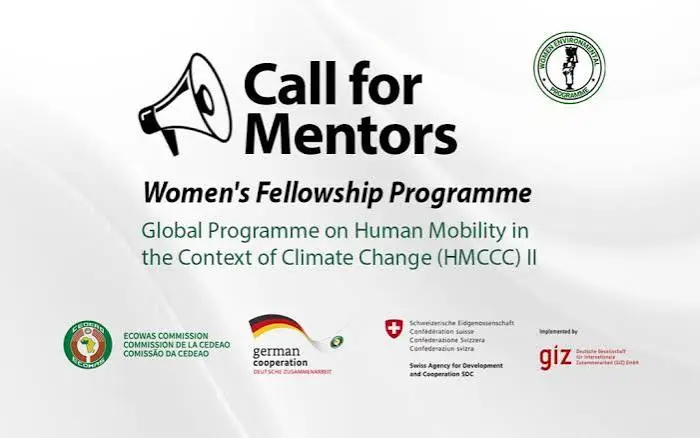
Implemented by the Women Environmental Programme (WEP) under the Human Mobility in the Context of Climate Change (HMCCC) Programme, the fellowship seeks to equip participants with practical skills, mentorship, funding opportunities, and regional networks to advance gender-responsive climate action.
Applications remain open until 19 July 2026.
Addressing Climate Mobility Through Women’s Leadership
Climate change continues to reshape livelihoods across West Africa, contributing to increasing levels of displacement and migration. Women are among the most affected by these climate-related challenges due to existing social and economic inequalities, yet they remain underrepresented in climate mobility decision-making and policy development.
The Women’s Fellowship on Human Mobility in the Context of Climate Change aims to bridge this gap by empowering emerging women leaders to participate actively in climate governance while developing innovative, community-driven responses to climate-induced human mobility.
The fellowship is funded by Deutsche Gesellschaft für Internationale Zusammenarbeit (GIZ) GmbH, co-financed by the Swiss Development Cooperation (SDC), and commissioned by Germany’s Federal Ministry for Economic Cooperation and Development (BMZ).
About the Fellowship
The six-month leadership programme will run from July to December 2026 using a hybrid learning model that combines:
Virtual orientation sessions
In-person capacity-building workshops
Individual mentorship
Community project implementation
Regional networking opportunities
The initiative is designed to strengthen the capacity of young women working at the intersection of climate change, migration, gender equality, environmental sustainability, and community development.
Eligible Countries
Applications are open to young women from selected ECOWAS Member States, including:
Anglophone Countries
Nigeria
Ghana
Gambia
Liberia
Sierra Leone
Francophone Countries
Benin
Côte d’Ivoire
Guinea
Senegal
Togo
Lusophone Countries
Cape Verde
Guinea-Bissau
Fellowship Objectives
The programme seeks to achieve several key outcomes, including:
Fellowship opportunities database
Strengthening women’s leadership in climate mobility governance
Increasing women’s participation in climate and migration policy processes
Building practical skills for addressing climate-induced migration using gender-responsive approaches
Supporting fellows to develop and implement community-based climate mobility projects
Promoting regional collaboration and knowledge exchange among emerging women leaders
Increasing women’s representation in regional and international climate discussions
Fellowship Structure
The fellowship is divided into three comprehensive phases designed to combine learning with practical action.
Phase One: Capacity Building
Selected fellows will participate in a fully funded leadership training programme covering topics such as:
Climate mobility in West Africa
Gender mainstreaming in climate and migration policy
Policy engagement and advocacy
Leadership development
Community impact strategies
Regional experts and experienced mentors will facilitate the sessions, with bilingual learning materials and simultaneous English-French interpretation available throughout the programme.
Phase Two: Mentorship and Pilot Projects
Each fellow will receive personalized support through:
Dictionaries & Encyclopedias
One-on-one mentorship with experienced professionals
Monthly coaching sessions
Technical guidance throughout project implementation
Participants will also become eligible for pilot project grants ranging from USD 500 to USD 1,000 to develop or expand community-based initiatives.
Eligible projects may include:
Climate mobility research
Community resilience programmes
Awareness and education campaigns
Policy advocacy initiatives
Livelihood improvement projects
Evidence-generation activities
Capacity-building programmes for vulnerable communities
Phase Three: Regional and Global Engagement
Outstanding fellows may receive support to participate in regional and international conferences and policy platforms focusing on:
Climate change
Migration
Gender equality
Sustainable development
Support may include:
Policy brief development
Networking opportunities
Event preparation coaching
Language interpretation services
Alumni Network and Continued Support
After completing the fellowship, participants will become members of a regional Community of Practice and Alumni Network, providing ongoing access to:
Peer learning opportunities
Quarterly knowledge-sharing sessions
Regional collaboration initiatives
Networking with climate and development professionals
Future leadership and career opportunities
Eligibility Criteria
The fellowship is open to young women aged 18 to 35 years from eligible ECOWAS countries who demonstrate a strong commitment to climate action and community leadership.
Applicants should:
Have leadership experience in climate change, migration, environmental sustainability, gender advocacy, youth engagement, or community development
Be actively involved in civil society, research, policy advocacy, or community initiatives
Present a project idea or ongoing initiative addressing climate-related human mobility
Demonstrate commitment to policy influence and community impact
Be available to participate throughout the six-month fellowship
Possess strong communication skills and an interest in multilingual collaboration
Application Requirements
Interested candidates must submit the following documents as a single Word or PDF file:
A motivation letter (maximum one page)
Curriculum Vitae (maximum two pages)
Project proposal describing a climate mobility initiative (maximum three pages)
Applicants should submit their applications via email using the subject line:
Dictionaries & Encyclopedias
HMCCC Fellowship Application – Applicant Name – Country
Why Apply?
The Women’s Fellowship on Human Mobility in the Context of Climate Change provides more than leadership training. It offers young women an opportunity to influence climate policy, access funding, collaborate with regional experts, and build sustainable solutions for communities affected by climate-induced displacement across West Africa.
The programme combines technical learning, mentorship, practical implementation, and international exposure, making it an excellent opportunity for emerging women leaders seeking to drive inclusive climate action within the ECOWAS region.
How to apply