Article
Read the full piece
There is a version of you that the world knows.
It is the person who appears in photographs, attends meetings, answers messages, posts achievements, shakes hands, smiles at opportunities, and tells people what you believe.
Then there is another version of you.
The one who makes decisions when nobody is checking. The one who handles money when there is no receipt to produce. The one who speaks about people who are not in the room. The one who responds to temptation when there is no fear of being caught. The one who behaves differently when there is nothing to gain.
Which version is the real you?
We live in an age where it is easier than ever to manage an image. Social media allows us to edit photographs, carefully select achievements, hide failures and present a life that looks more successful, exciting and complete than it actually is.
But character cannot be filtered forever.
Eventually, life takes us into rooms where there is no audience, no camera and no applause.
That is where integrity begins to speak.
Integrity Is More Than Telling the Truth
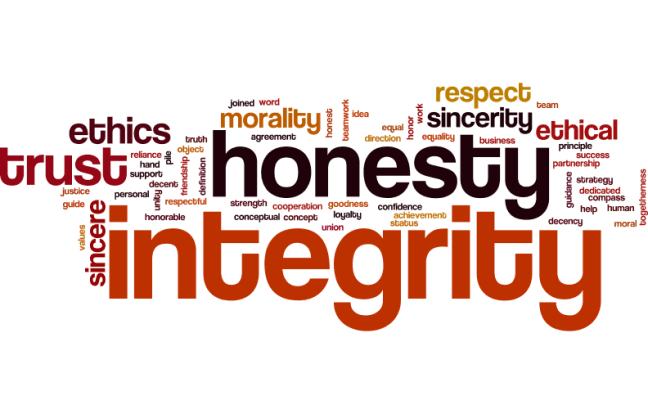
Integrity is often reduced to one simple word: honesty.
Honesty matters, but integrity reaches further.
Integrity is the alignment between what you believe, what you say and what you actually do. It is consistency between your principles and your behaviour.
You say you value fairness—and then you practise fairness when you have power.
You say you value honesty—and then you tell the truth when lying would benefit you.
You say people deserve respect—and then you treat people with dignity even when they cannot advance your interests.
That is integrity.
Imagine a professional who discovers that changing a few figures would make a project appear more successful. The adjustment could impress senior management and perhaps even improve the person's chances of promotion.
Nobody may notice.
The temptation is real.
Integrity asks a difficult question: What kind of person will I become if I make this choice?
The immediate reward may be attractive. But character is shaped by repeated decisions, especially the decisions nobody applauds.
Integrity is the part of your character that remains standing when reputation has nothing to protect you.
Authenticity Means Being Real—and Responsible
Authenticity is another word that is often misunderstood.
Some people interpret “being authentic” as saying whatever they want, doing whatever feels natural and refusing to change.
That is not authenticity.
Authenticity begins with self-awareness. It means knowing your values, recognising your strengths and weaknesses, acknowledging your convictions, and having the courage to live honestly rather than constantly performing for approval.
But authenticity also requires responsibility.
If someone says, “That's just who I am,” to justify dishonesty, cruelty or disrespect, they are not demonstrating authenticity. They are avoiding accountability.
You can be genuine and still grow.
You can be confident and still accept correction.
You can hold strong convictions and still listen.
You can know who you are without believing you have nothing left to learn.
Authenticity is not refusing to change; it is refusing to pretend that you are someone you are not while having the humility to become better.
Integrity and Authenticity Need Each Other
Integrity and authenticity are closely connected, but they are not identical.
Authenticity asks:
“Am I being honest about who I am?”
Integrity asks:
“Am I living according to what I know is right?”
Authenticity without integrity can become self-expression without responsibility.
Integrity without authenticity can become outward conformity—a person who appears respectable while living disconnected from their real values.
Together, they create something stronger: a life in which your inner convictions and outward actions increasingly agree.
That kind of life does not require constant performance.
You do not have to remember which version of yourself you showed to which audience.
You can simply be yourself—and take responsibility for the person you are becoming.
The Private-Public Test
Here is one of the simplest tests of character:
Would you make the same decision if you knew nobody would ever find out?
Would you still return money that was mistakenly given to you?
Would you still give credit to a colleague who helped you?
Would you still keep a promise if breaking it would be easier?
Would you still refuse to cheat if there were absolutely no chance of being caught?
Would you still treat a cleaner, security guard, intern or waiter with respect if they had nothing to offer you?
Private decisions are powerful because they expose motivation.
When recognition disappears, what remains?
Character is often revealed in the space between temptation and decision.
The Pressure to Perform
Modern life creates enormous pressure to look successful.
Someone posts a new car.
Another announces a promotion.
Someone shares a perfect relationship photograph.
Another displays an expensive holiday.
Someone appears to have a thriving business before they have even made their first meaningful profit.
After seeing enough of this, it becomes easy to confuse visibility with value.
A young person may begin spending money they do not have simply to maintain an image. Someone may exaggerate achievements on LinkedIn or a CV. Another may create an online personality that bears little resemblance to their private life.
The danger is not social media itself.
The danger is allowing other people's perception of us to become more important than our actual character.
A carefully constructed image can attract attention.
Only genuine character can sustain trust.
Your public image may introduce you to people, but eventually your character will have the longer conversation.
When Integrity Costs You Something
Integrity is easiest to celebrate when it is convenient.
The real test comes when doing the right thing costs something.
Perhaps honesty costs you a promotion.
Perhaps keeping your word costs you time.
Perhaps refusing an unethical business shortcut costs you money.
Perhaps telling the truth damages your popularity.
Perhaps standing by your values means disappointing people whose approval you wanted.
This is why integrity cannot be measured simply by what someone says they believe.
Principles become visible when they become expensive.
Consider a business owner who discovers a cheaper way to operate but knows it involves misleading customers. The shortcut could increase profits.
The ethical choice may not produce an immediate reward.
But every business transaction is also building something invisible: trust.
Money can measure revenue.
It cannot fully measure credibility.
And once credibility is destroyed, rebuilding it can take far longer than earning the original profit.
Authenticity Does Not Mean Arrogance
There is another trap.
A person can become so determined to “be themselves” that they stop listening to anyone.
“I am just being authentic,” they say.
But authenticity does not eliminate accountability.
If several trusted people point out that your behaviour is hurting others, authenticity should not become a shield against reflection.
Real self-awareness includes the ability to ask:
“Is this truly who I am, or is this simply a habit I have never challenged?”
Growth sometimes requires admitting that something we once considered part of our identity needs to change.
You can remain true to your deepest values while changing your methods, attitudes and behaviours.
That is not hypocrisy.
That is maturity.
Small Choices Are Quietly Building Your Character
Character rarely appears fully formed.
It is assembled through ordinary decisions.
You keep a promise.
You admit that you were wrong.
You return something that does not belong to you.
You protect someone's confidence.
You give credit instead of taking it.
You arrive when you said you would.
You tell the truth even when a convenient half-truth would be easier.
You refuse to participate in gossip.
You treat people fairly when nobody important is watching.
None of these moments may become a social media post.
But they matter.
Every decision is, in a small way, a vote for the person you are becoming.
The Leader Who Admits the Mistake
Leadership provides a particularly powerful test.
Imagine a leader whose decision has caused a project to fail.
They could blame the team.
They could hide the mistake.
They could manipulate the report.
Or they could stand before their colleagues and say:
“I made the decision. It did not work. Here is what I learned, and here is what I will do differently.”
That admission may feel uncomfortable.
But it creates something valuable: trust.
People do not need leaders who never make mistakes.
They need leaders who can be trusted with mistakes.
The same principle applies in families, friendships, workplaces, classrooms and communities.
Accountability does not make a person smaller. It makes their character more believable.
The Integrity Audit
Take a few quiet minutes and answer these questions honestly. Not with the answer that sounds impressive—the answer that is true.
If someone could observe my private decisions for one week, would they recognise the same values I display publicly?
Which promise do I regularly keep only when it is convenient, and what does that reveal about me?
How do I behave toward people who have no authority, money or influence over my future?
When I make a mistake, is my first instinct to take responsibility or construct an explanation?
What part of my online presence would look different if I stopped seeking approval from other people?
Where am I tempted to compromise a principle because the reward is attractive?
Which values do I talk about most—and where does my behaviour still contradict them?
Who can tell me an uncomfortable truth without fearing that I will reject them?
What am I pretending not to know about myself because acknowledging it would require change?
If recognition, money and applause disappeared tomorrow, what part of my life would still make me proud?
Do not rush these questions.
Sometimes the most important answers are the ones we initially want to avoid.
The 7-Day Integrity & Authenticity Challenge
You do not need to transform your entire life overnight. Begin with small decisions.
Day 1: Keep One Difficult Promise
Identify one commitment you have been tempted to postpone or abandon. Honour it today.
Day 2: Tell One Uncomfortable Truth
Have one conversation where honesty would be more difficult than giving the convenient answer. Be truthful without being cruel.
Day 3: Give Credit
Find someone whose contribution has been overlooked and acknowledge it publicly or privately.
Day 4: Remove One Performance
Look at your social media behaviour. Identify one thing you post, exaggerate or maintain mainly to create an impression. Stop performing for one day.
Day 5: Admit a Mistake
Take responsibility for something without adding a long list of excuses or shifting blame.
Day 6: Do the Right Thing Unseen
Choose an ethical action that nobody is likely to notice. Do it without telling anyone.
Day 7: Write Your Personal Code
Write down five values you genuinely want your life to represent. Then beside each one, write one behaviour that would demonstrate that value in everyday life.
Keep the list.
Return to it when making difficult decisions.
The Long-Term Power of Character
Integrity does not always produce immediate rewards.
Sometimes the dishonest person appears to advance faster.
Sometimes the person who exaggerates receives more attention.
Sometimes the person who refuses shortcuts seems to be falling behind.
But character operates on a different timeline.
Over time, people remember who kept their word.
They remember who could be trusted with confidential information.
They remember who accepted responsibility.
They remember who treated people with dignity when there was nothing to gain.
They remember who remained consistent when circumstances changed.
That is how credibility is built.
And credibility creates opportunities that performance alone cannot sustain.
The same is true internally.
When your actions repeatedly match your values, you develop a quiet form of confidence. You no longer have to constantly manage appearances because you know who you are.
You may still have weaknesses.
You may still make mistakes.
You may still have growing to do.
But you are not living a divided life.
When the Applause Disappears
Perhaps the deepest question about integrity and authenticity is not, “What do people think about me?”
It is:
“Who am I becoming?”
Because applause eventually fades.
Followers come and go.
Trends change.
Job titles change.
Money rises and falls.
Popularity is temporary.
Even the image we spend so much energy protecting will eventually be replaced by another image.
What remains is character.
The student who refuses to cheat is building something.
The professional who refuses to falsify results is building something.
The leader who admits a mistake is building something.
The young person who refuses to abandon their values for acceptance is building something.
The business owner who chooses ethical practices over dishonest profit is building something.
They are building a life that does not depend entirely on being watched.
And perhaps that is one of the greatest freedoms a person can possess:
to live in such a way that the person you are in private does not embarrass the person you present in public.
Your reputation is what other people discover about you.
Your character is what you repeatedly choose when they are not there.
So when the room is empty, the phone is silent, the audience is gone and nobody is keeping score, there is still one person present.
You.
And that is where the real work of becoming yourself begins.
Final Reflection
Before you close this article, sit with this question for a moment:
If nobody could ever applaud you, reward you, promote you or discover what you do in private, what choices would reveal the person you truly are?
More from the journal