Article
Read the full piece
You have the qualifications.
You have the experience.
You have the skills.
You apply for jobs that match your background—but the interview invitation never comes.
After dozens of applications, you may start asking yourself:
“Am I really not good enough?”
Not necessarily.
Sometimes, the problem is not your ability to do the job. The problem is that your CV is not effectively communicating your qualifications to the recruitment system and the people reviewing it.
This is where an ATS-friendly CV can make a major difference.
Your CV is often the first introduction an employer has to your professional story. Before a recruiter may carefully read it, an Applicant Tracking System (ATS) may process the document, identify relevant information, and help organize candidates for further review.
The goal is not to trick the system.
The goal is to make your real qualifications easier to identify.
The Reality Behind “I Applied But Never Heard Back”
Job seekers often assume that applying for a position means their CV has been seen by a recruiter.
In many recruitment processes, that may not be the case.
Employers can receive hundreds or even thousands of applications for a single position. Recruitment technology helps organizations manage these applications more efficiently.
This means your CV may need to perform two important jobs:
Be readable and compatible with recruitment technology.
Convince the recruiter that you are worth considering.
If your CV fails to clearly communicate your relevant qualifications, you may lose visibility before your experience gets the attention it deserves.
That is why an ATS-friendly CV is more than a formatting preference.
It is a job-search strategy.
What Exactly Is an ATS-Friendly CV?
An ATS-friendly CV is a CV structured and written in a way that makes it easier for recruitment systems and human reviewers to identify relevant information.
It typically includes:
clear and standard section headings
relevant keywords from the job description
simple, readable formatting
clearly stated job titles
measurable achievements
relevant technical and professional skills
properly organized employment history
consistent dates and information
easy-to-read language
accurate information that reflects your real experience
The objective is simple:
Make your qualifications easy to find, understand, and evaluate.
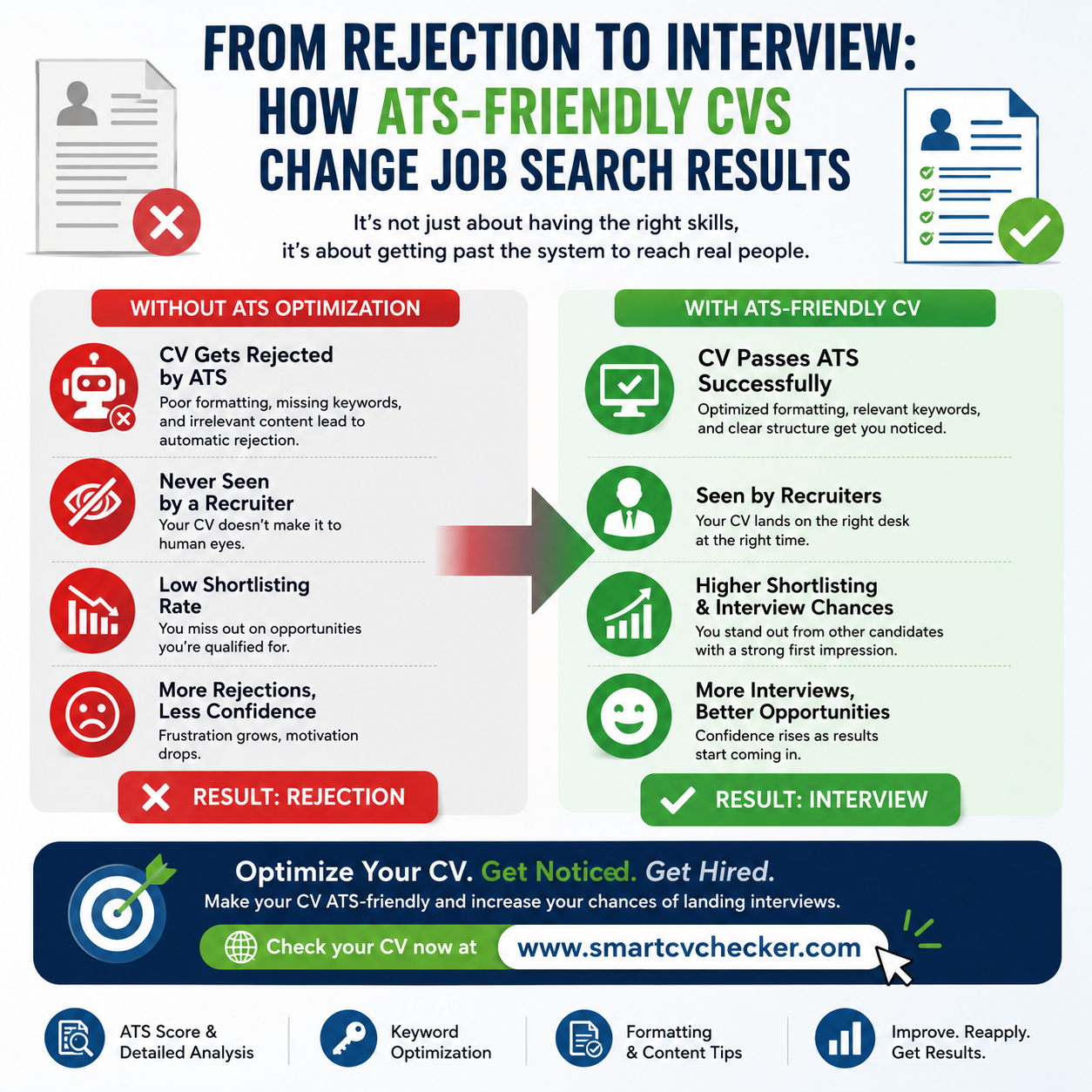
From Rejection to Recognition
Consider two candidates with similar qualifications.
Both have three years of experience.
Both have relevant academic qualifications.
Both possess the required technical skills.
Both apply for the same position.
However, Candidate A submits a CV containing:
an unclear professional summary
generic descriptions
limited job-specific keywords
complicated formatting
responsibilities without measurable results
inconsistent job titles
poorly organized information
Candidate B submits a CV containing:
a targeted professional summary
relevant keywords
clearly defined skills
standard headings
measurable achievements
consistent employment information
simple, professional formatting
Candidate B has not necessarily become more qualified.
Candidate B has simply made their qualifications easier to recognize.
That distinction can completely change how a job application performs.
1. Start With the Job Description
One of the biggest mistakes job seekers make is using exactly the same CV for every application.
A CV should reflect the opportunity you are applying for.
Before editing your CV, carefully study the job description.
Look for:
required qualifications
technical skills
software and systems
industry terminology
years of experience
functional responsibilities
certifications
leadership requirements
communication skills
project management requirements
reporting responsibilities
other recurring terms
These words help you understand what the employer considers important.
Your CV should then demonstrate—truthfully—where you possess those qualifications.
2. Use Keywords Honestly
Keywords matter because they help connect your CV with the requirements of a position.
For example, if a job description repeatedly mentions:
“financial reporting,” “budget management,” “reconciliation,” and “tax compliance,”
and you genuinely have experience in these areas, make sure your CV communicates that clearly.
Instead of writing:
Responsible for handling financial duties.
You could write:
Prepared financial reports, performed account reconciliations, supported budget monitoring, and maintained tax compliance records.
The second version provides much more useful information.
It communicates what you actually did using terminology relevant to the role.
3. Stop Hiding Your Achievements
Many CVs describe responsibilities but fail to demonstrate results.
There is a major difference between:
“Prepared monthly reports.”
and
“Prepared monthly financial reports to support management decision-making and improve reporting accuracy.”
The second statement communicates purpose and value.
Whenever possible, show:
what you accomplished
what you improved
what you managed
what you delivered
how many people or projects you supported
how frequently you performed the task
measurable improvements you contributed to
Your CV should answer an important question:
“What value did this person create?”
4. Make Your Professional Summary Work Harder
Your professional summary is one of the first sections recruiters may read.
Avoid filling it with generic phrases such as:
Hardworking, motivated and committed individual seeking a challenging opportunity.
Thousands of candidates could say the same thing.
Instead, communicate your professional identity and strongest value.
For example:
Results-driven finance professional with experience in financial reporting, account reconciliation, tax compliance, transaction verification and financial records management, with a strong track record of supporting accurate and efficient financial operations.
This immediately gives the reader a clearer picture of the candidate.
5. Use Standard CV Sections
Recruitment technology works more effectively when information is organized clearly.
Consider using familiar headings such as:
Professional Summary
Professional Experience
Education
Skills
Certifications
Professional Affiliations
Leadership Experience
Achievements
Avoid creating unnecessarily complicated section names.
Your creativity should be demonstrated through your content and achievements, not by making essential information difficult to locate.
6. Keep Your Formatting Simple and Professional
A beautiful CV is not automatically an effective CV.
Heavy graphics, decorative elements, complex layouts, excessive columns, unusual fonts and information placed inside difficult-to-read design elements can create unnecessary compatibility challenges.
A professional CV should prioritize:
Clarity → Relevance → Readability → Professional presentation
Your CV does not need to look like a magazine cover.
It needs to communicate your professional value quickly and clearly.
7. Tailor Your CV for Each Application
One of the most powerful changes you can make to your job-search strategy is to stop treating every application the same.
Different employers emphasize different qualifications.
A project management position may prioritize:
project planning
stakeholder engagement
monitoring and evaluation
reporting
budgeting
risk management
A finance position may prioritize:
financial reporting
reconciliation
budgeting
taxation
audit support
compliance
Your CV should emphasize the qualifications most relevant to the specific opportunity.
One career does not require one CV version.
Your master CV can contain your full professional history, while tailored versions highlight what matters most for each opportunity.
8. Don't Try to Trick the ATS
There is a dangerous misconception that ATS optimization means hiding keywords or adding hundreds of unrelated terms.
It does not.
Do not:
add skills you do not possess
copy entire job descriptions into your CV
hide keywords using invisible text
exaggerate your experience
misrepresent job titles
claim qualifications you do not have
The strongest ATS strategy is truthful alignment.
Find the requirements you genuinely meet and communicate them clearly.
Optimization should improve the visibility of your qualifications—not manufacture qualifications you don't have.
9. Test Your CV Before You Apply
One of the biggest changes in modern job searching is that you no longer have to wait for an employer to tell you that something is wrong.
You can review your CV before submitting it.
Ask yourself:
Relevance
Does my CV clearly match the position?
Keywords
Have I naturally included relevant terminology from the job description?
Structure
Can someone quickly find my experience, education and skills?
Achievements
Have I demonstrated results rather than simply listing duties?
Readability
Is the document easy to scan?
Accuracy
Are my dates, titles, qualifications and other details correct?
ATS compatibility
Is the CV structured in a way that recruitment technology can process effectively?
This simple review can turn an application from “submitted” into a much stronger representation of your professional value.
10. Understand What ATS Optimization Can—and Cannot—Do
An ATS-friendly CV is not a magic ticket to employment.
It cannot guarantee an interview.
It cannot replace qualifications.
It cannot compensate for a lack of relevant experience.
And it cannot make an unsuitable candidate suitable.
What it can do is help ensure that your genuine qualifications are presented clearly and are easier to identify.
That matters because a strong candidate can still lose an opportunity if their CV fails to communicate their relevance effectively.
The Job Search Equation Is Changing
Traditional job searching often looked like this:
Find job → Submit CV → Wait
Modern job searching should look more like:
Find opportunity → Analyze requirements → Tailor CV → Check ATS compatibility → Submit → Track → Improve
That is a completely different mindset.
Instead of sending 100 identical applications, focus on submitting better-targeted applications.
Instead of asking:
“How many jobs have I applied for?”
Start asking:
“How strong is each application I submit?”
Your CV Should Pass Two Tests
A powerful CV needs to satisfy two audiences.
Test 1: The Recruitment System
Can the system identify:
your job titles?
your skills?
your qualifications?
your experience?
your relevant keywords?
Test 2: The Recruiter
Can the recruiter quickly understand:
who you are?
what you can do?
what you have achieved?
how relevant you are?
what value you could bring?
Passing only one test is not enough.
Your CV needs to be machine-readable and human-persuasive.
From Rejection to Interview: The Transformation
An ATS-friendly CV does not change who you are.
It changes how effectively your professional story is communicated.
You may already have:
The degree.
The experience.
The skills.
The achievements.
The potential.
But if those strengths are buried beneath poor structure, generic language or irrelevant information, employers may struggle to recognize them.
ATS optimization helps bring the most relevant parts of your professional story forward.
And that is the real transformation:
From being overlooked → to being recognized.
From submitting blindly → to applying strategically.
From simply having a CV → to having a job-search tool.
Don't Guess. Check Your CV.
Before submitting your next application, take a few minutes to evaluate your CV.
Ask yourself:
Is my CV actually optimized for the jobs I am applying for?
If you are not sure, use Smart CV Checker to review your CV and identify areas that may need improvement.
Instead of guessing whether your CV is ready, check it before you apply.
Your next interview could begin with a better CV.
Check it. Improve it. Apply with confidence.
Smart CV Checker is designed to help job seekers assess and improve their CVs so they can approach the job market with greater confidence and strategy.
More from the journal
Related reading

How to Beat Applicant Tracking Systems Without Lying on Your CV

10 African Careers That Could Grow Rapidly Before 2030