
Article
Read the full piece
Have you ever applied for a job you were genuinely qualified for, only to receive no response?
You had the right degree.
You had relevant experience.
You had the required skills.
You carefully prepared your application.
Yet, somehow, your CV never seemed to reach the recruiter.
Before you conclude that you are not good enough, there is something important you need to understand: your CV may be losing the competition before a human being even reads it.
Welcome to the world of Applicant Tracking Systems (ATS).
ATS technology has transformed recruitment. Employers can now receive hundreds or thousands of applications for a single position and use software to organize, filter, and identify candidates who appear most relevant to the role.
But this has also created a challenge for job seekers.
Some candidates respond by exaggerating their experience, adding skills they do not possess, changing job titles, or even inventing qualifications.
That is not the solution.
You do not need to lie on your CV to beat an ATS.
You need to learn how to present your real qualifications in a way that both technology and recruiters can understand.
What Is an Applicant Tracking System?
An Applicant Tracking System is software that helps employers manage the recruitment process.
Depending on the system and employer, an ATS may help with:
Collecting applications
Parsing CVs
Identifying keywords
Filtering candidates
Organizing applicant information
Searching candidate databases
Supporting candidate ranking and shortlisting
The ATS is essentially designed to help recruiters manage large volumes of applications.
This means your first challenge is not always the recruiter.
Sometimes, your first audience is the recruitment technology.
The Biggest Misunderstanding About ATS
Many job seekers think "beating ATS" means tricking the system.
It doesn't.
ATS optimization is not about manipulating recruitment software. It is about making sure your genuine qualifications are:
Relevant
Clearly presented
Easy to identify
Properly structured
Aligned with the position
Supported by evidence
Think of it this way:
Your experience is the product. Your CV is the packaging. ATS optimization makes sure the packaging clearly communicates what is inside.
You should never change the product just to make the packaging look better.
1. Start With the Job Description
One of the most powerful ATS strategies is also one of the simplest:
Read the job description carefully.
Before editing your CV, identify what the employer is actually looking for.
Look for:
Required qualifications
Technical skills
Soft skills
Job responsibilities
Industry terminology
Software and tools
Certifications
Experience requirements
Job-specific terminology
These words and phrases provide clues about what should be emphasized in your CV.
2. Use Relevant Keywords — Honestly
Keywords are important because ATS systems may look for terms that are relevant to the vacancy.
Suppose a job advertisement asks for:
Financial reporting
Budget management
Tax compliance
Account reconciliation
Excel
Financial analysis
If you genuinely have these skills, make sure they are clearly reflected in your CV.
Do not replace "I have never done this" with "I am an expert."
Instead, identify the parts of your actual experience that are relevant.
For example:
Instead of:
Hardworking finance professional looking for an opportunity.
Consider:
Results-driven finance professional with experience in financial reporting, account reconciliation, tax compliance, budgeting, and financial records management.
The second version communicates your actual capabilities much more effectively.
3. Never Add Skills You Do Not Have
This is where ethical ATS optimization becomes extremely important.
Do not add a skill simply because it appears in the job description.
If the employer requires Python and you have never used Python, do not add Python to your skills section just to increase keyword matching.
If the position requires five years of project management experience and you have two years, do not change your dates.
If you have never managed a multimillion-dollar budget, do not claim that you have.
ATS optimization should improve how you communicate your qualifications — not manufacture qualifications you do not possess.
4. Translate Your Experience Into Employer Language
Sometimes you have the right experience but describe it using completely different terminology.
For example, an employer may request:
"Stakeholder engagement"
Your CV may say:
"Worked closely with community leaders, partners, government representatives, and project beneficiaries."
These experiences may be relevant, but the connection may not be immediately obvious.
A stronger version could be:
"Managed stakeholder engagement with community leaders, government representatives, partners, and project beneficiaries."
This is not lying.
You are simply using professional terminology that accurately describes your work.
5. Use Standard CV Headings
ATS systems generally work better when information is organized using familiar sections.
Use headings such as:
Professional Summary
Core Competencies
Work Experience
Education
Professional Certifications
Professional Training
Technical Skills
Professional Affiliations
Avoid making your CV unnecessarily complicated.
Your creativity should be demonstrated through your achievements and professional positioning — not through confusing section names.
6. Keep Your CV Easy to Read
A CV does not need to be complicated to look professional.
In fact, simplicity can be your advantage.
Be cautious with excessive use of:
Graphics
Images
Icons
Text boxes
Decorative elements
Complicated tables
Multiple-column layouts
Different ATS platforms handle formatting differently, so there is no single design rule that guarantees compatibility with every system.
The safest approach is generally to prioritize a clean, structured, text-readable format and follow the employer's file-format instructions.
7. Turn Responsibilities Into Achievements
Your CV should not simply tell employers what you were responsible for.
It should show them what you achieved.
Compare these two statements:
Duty-focused:
Responsible for managing customer complaints.
Achievement-focused:
Resolved customer complaints efficiently while supporting improved customer service delivery and client satisfaction.
Where possible, add genuine numbers:
Managed an average of 100+ customer inquiries weekly while maintaining timely resolution and accurate service records.
Numbers make your contribution easier to understand.
And remember: never invent statistics just to make your CV look impressive.
8. Use the Correct Job Title — Without Misrepresenting Yourself
Job titles can sometimes create ATS challenges.
Suppose your official title was:
Administrative Assistant
but much of your work involved:
Project Coordination
Do not simply change your official title to "Project Manager."
Instead, you can accurately communicate the relationship:
Administrative Assistant | Project Coordination Support
Then explain the actual project-related responsibilities you performed.
This allows you to highlight relevant experience without falsifying your employment history.
9. Tailor Your CV for the Specific Position
One CV cannot effectively communicate everything you have ever done.
Your CV should tell a focused career story.
If you are applying for a Monitoring and Evaluation position, emphasize relevant experience such as:
Data collection
Data analysis
Reporting
Indicators
Performance measurement
Project monitoring
Stakeholder reporting
If you are applying for a Finance position, emphasize:
Financial reporting
Budgeting
Reconciliation
Audit support
Tax compliance
Accounts management
Your career may be broad, but your CV should be strategically focused.
10. Optimize Your Professional Summary
Your professional summary should immediately answer three questions:
Who are you?
What can you do?
What value do you bring?
Avoid generic statements such as:
"I am a hardworking, committed, and motivated individual seeking a challenging opportunity."
Almost every applicant could write that.
Instead, communicate your professional value.
For example:
"Results-driven Monitoring and Evaluation professional with experience in data collection, performance tracking, reporting, stakeholder engagement, and evidence-based program improvement."
Specificity is more powerful than empty adjectives.
11. Use Both Technical and Transferable Skills
Sometimes candidates focus only on technical skills and forget transferable competencies.
Depending on the position, relevant skills may include:
Technical Skills
Data Analysis
Financial Reporting
Project Management
Monitoring and Evaluation
Budget Management
Procurement
Research
Digital Tools
Transferable Skills
Leadership
Communication
Problem Solving
Team Collaboration
Stakeholder Engagement
Analytical Thinking
Time Management
Only include skills that you can genuinely demonstrate.
12. Proofread Your CV
An ATS may not recognize a keyword if it is misspelled.
For example:
"Managment"
instead of:
"Management"
A spelling mistake can also make a poor impression on the recruiter.
Before submitting your CV, check:
Spelling
Grammar
Dates
Job titles
Contact information
Company names
Qualifications
Formatting
Keyword accuracy
Professionalism is in the details.
13. Test Your CV Before You Apply
This is one step many job seekers overlook.
Instead of submitting your CV repeatedly and hoping for better results, test it before applying.
A CV analysis tool can help you identify areas that may need improvement, including:
ATS compatibility
Keyword alignment
Missing skills
Resume structure
Content gaps
Formatting concerns
One platform you can use for this is Smart CV Checker.
Check Your CV Before Your Next Application
Visit:
Use Smart CV Checker to assess your CV, identify areas for improvement, and make your resume more competitive before submitting your next application.
Don't wait for another rejection to discover that your CV needed improvement.
Check it. Improve it. Apply with confidence.
ATS Optimization Is Not About Cheating
There is an important difference between optimization and deception.
Optimization means:
Using relevant keywords
Tailoring your CV
Clarifying your experience
Highlighting genuine achievements
Improving formatting
Communicating your skills clearly
Deception means:
Inventing qualifications
Adding fake experience
Creating false achievements
Changing employment dates
Claiming skills you do not have
Inventing certifications
The first can strengthen your application.
The second can destroy your professional reputation.
Your CV Should Pass Two Tests
A successful modern CV needs to satisfy two audiences.
Test One: The ATS
The system should be able to identify:
Your skills
Your experience
Your qualifications
Your job history
Your relevant keywords
Test Two: The Recruiter
The recruiter should be able to quickly understand:
Who you are
What you have achieved
What you can do
Why you are relevant
What value you could bring
The goal is not to create a CV that only passes an ATS.
The goal is to create a CV that passes the technology and impresses the human being behind it.
Stop Asking, "How Do I Trick the ATS?"
Start asking:
"How do I make my genuine qualifications easier for the ATS and recruiter to recognize?"
That mindset changes everything.
You don't need to become someone you are not.
You need to communicate who you are more effectively.
Your experience already has value.
Your education already has value.
Your skills already have value.
Your achievements already have value.
Your CV simply needs to present that value strategically.
Final Thoughts
Applicant Tracking Systems have changed the way employers recruit. But ATS technology should not force job seekers to compromise their honesty.
You don't need fake qualifications.
You don't need invented experience.
You don't need exaggerated achievements.
You need a clear, relevant, tailored, and ATS-friendly CV that accurately represents what you can offer.
The smartest job seekers are not trying to fool the recruitment system. They are learning how the system works and using that knowledge to communicate their real value more effectively.
Before submitting your next application, take a few minutes to evaluate your CV with Smart CV Checker at www.smartcvchecker.com.
Don't just apply for jobs. Optimize your opportunity to be seen.
More from the journal
Related reading
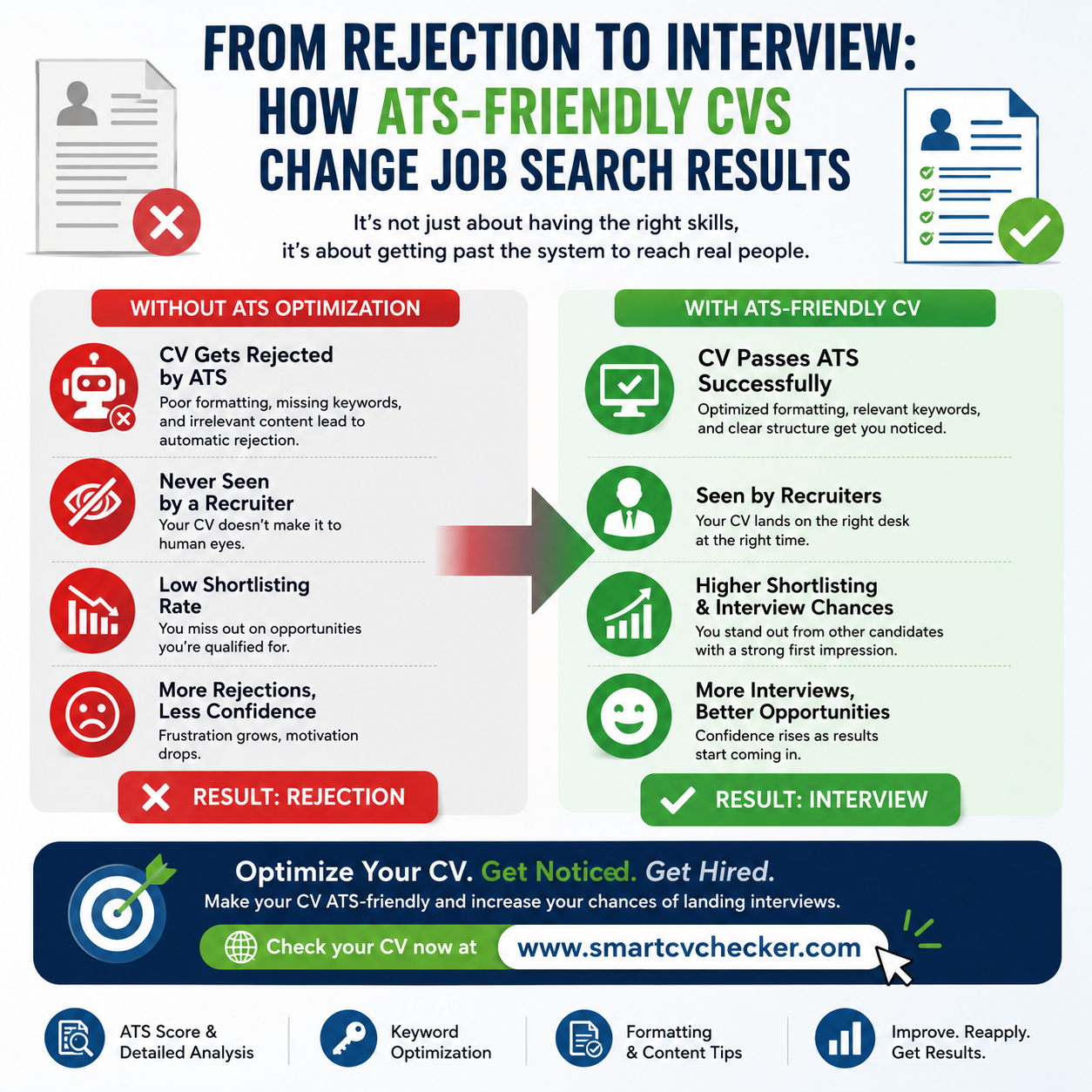
From Rejection to Interview: How ATS-Friendly CVs Change Job Search Results

10 African Careers That Could Grow Rapidly Before 2030