
About the opportunity
What this programme is offering
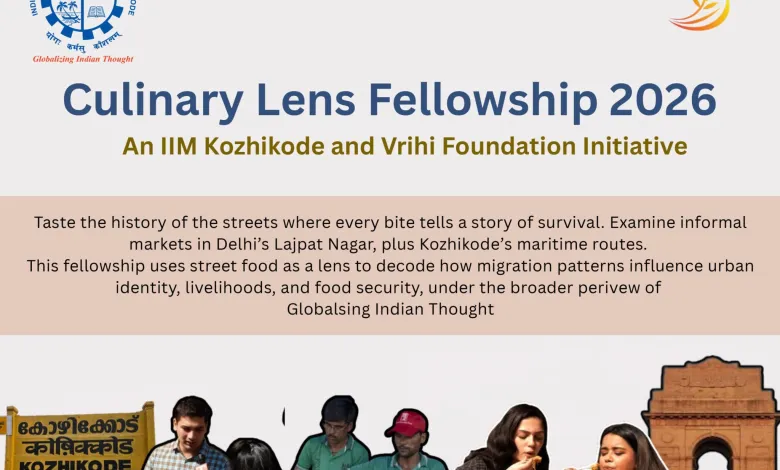
The India-Japan Centre on Climate and Culture at , in collaboration with the Vrihi Foundation, announces the inaugural Culinary Lens Fellowship for 2026. This fellowship invites young researchers in India to explore the food history of the Indian subcontinent through innovative and interdisciplinary approaches.
The program supports original work across formats, including:
Written research
Visual storytelling
Multimedia documentation
Experimental and hybrid outputs
The initiative aims to expand critical scholarship on food systems by foregrounding everyday practices such as street food vending and informal food economies.
Fully Funded Masters
About the Theme
The 2026 fellowship focuses on small, informal food businesses and street food markets in Delhi and Kozhikode as a lens to examine migration, identity, and livelihood/food security.
Urban governance often prioritizes structured, consumer-driven systems that favor privileged populations. In contrast, street food markets challenge these systems by:
Expanding access to affordable food
Supporting informal economies
Enhancing urban food security for marginalized populations
Street food ecosystems also serve as indicators of:
Cultural identity and continuity
Migration histories and patterns
Social adaptation within urban environments
Research has shown that migration into cities such as New Delhi and Kozhikode has shaped the diversity and segmentation of food markets. These markets reflect not only economic necessity but also evolving cultural identities rooted in regional histories.
The fellowship encourages scholars to examine how:
Migration influences food practices and vendor networks
Street food economies support livelihoods and resilience
Urban spatial dynamics shape informal markets
Fellowship Objectives
The fellowship uses street food vending as an entry point to analyze broader socio-economic and cultural processes. Key objectives include:
Studying socio-spatial segmentation in urban markets
Understanding migration-driven cultural transformations
Exploring food as a marker of identity and belonging
Assessing links between informal economies and food security
The first phase will focus on markets in New Delhi, specifically:
Chittaranjan Park
Lajpat Nagar
These areas are historically linked to refugee settlements following the Partition of India. In Kozhikode, selected markets will reflect connections to historical trade and migration routes, particularly maritime exchanges.
Expected Project Deliverables
Selected fellows will produce a comprehensive body of work, including:
A 5,000-word written research submission
A photo essay (12–15 images with contextual narratives)
An audio-visual or mixed-media archive
All final outputs must be submitted in English. Translations or subtitles are required for non-English primary data.
Timeline and Structure
The fellowship spans six months (part-time) and includes structured mentorship and research phases:
Mid-July 2026: Selection of two fellows
Late July 2026: Two-day initiation program at IIM Kozhikode
Four months: Fieldwork and first draft development
Final phase: Submission and review
Each fellow will be paired with mentors from both partner institutions to guide:
Research design
Fieldwork execution
Analytical development
Funding and Payment Structure
The fellowship offers a grant of INR 300,000 (subject to applicable taxes), disbursed in stages:
20% upon contract signing
30% after completion of primary surveys
30% upon submission of first draft and review participation
Final installment upon project completion
Eligibility Criteria
The fellowship is open to candidates who meet the following requirements:
Currently pursuing a master’s degree in:
Sociology
Anthropology
Urban Planning
Related social sciences
Demonstrated skills in qualitative research methods
Strong interest in food studies, migration, and urban systems
Proficiency in audio-visual documentation
Additional preferred qualifications include:
Experience with in-depth interviews and field research
Familiarity with sociological theory
Interest in food culture and practices
Ability to work independently and collaboratively
Strong communication and analytical skills
Applicants must either reside in or be able to travel to field locations at their own expense. The fellowship is non-transferable.
What the Fellowship Offers
Participants will gain access to a rich interdisciplinary research environment, including:
Collaboration with sociologists, historians, and archivists
Mentorship from leading experts
Exposure to innovative research methodologies
The program is anchored at the India-Japan Centre on Climate and Culture, with research and documentation guidance provided jointly by both partner organizations.
Application Process
Applicants must submit the following by 30 June 2026:
Research proposal (as per specified format)
Statement of purpose (maximum one page)
Curriculum vitae
Publication list (if available)
Reference letters (optional)
Proposal Structure
The proposal should include:
Title
Project overview
Problem statement
Background and context
Literature review
Objectives
Project design
Methodology
Expected outcomes
Timeline
Applicants are encouraged to clearly articulate research gaps, methodological approaches, and the broader significance of their work.
How to apply